
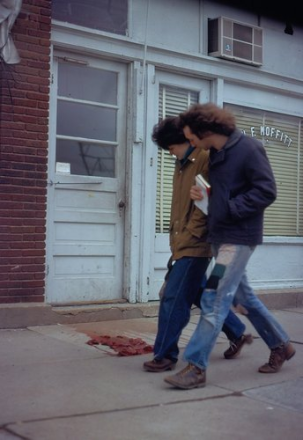
Ana Mendieta was a Cuban-American artist whose work explores themes such as displacement, the body, our relationship with nature, and the passing of time, primarily through sculpture, performance and photography. She worked mostly in New York City, where she lived from 1978, and where she was part of the feminist movement. A new exhibition at the Tate Modern presents over 120 of her works made from the mid-1960s to 1985.
Mendieta was born in Havana in 1948 to a well off family; her father was an attorney and nephew of Carlos Mendieta, interim president of Cuba from 1934-35. At the age of 12, Mendieta and her older sister, Raquelín, were sent to the United States as part of Operation Peter Pan - the US government and Catholic Church programme in which 14,000 Cuban children were moved to the US. The sisters arrived in Iowa, first living briefly in refugee camps and then in a series of institutions and foster homes until they were reunited with their mother and younger brother in 1966. Their father joined in 1979 after spending 18 years in prison for his involvement in the Bay of Pigs invasion.
EXILE
The experience of exile from Cuba shaped Mendieta’s artwork; ‘Having been torn from my homeland (Cuba) during my adolescence, I am overwhelmed by the feeling of being cast out from the womb (Nature). My art is the way I re-establish the bonds that unite me to the Universe.’ She returned in 1980 with the Círculo de la Cultura Cubana, an organisation promoting cultural exchange of which she was a member. The exhibition opens with photos of her ‘Esculturas Repuestres’ (‘Rupestrian Sculptures’) (1981), a series of carvings in the limestone rock at the Escaleras de Jaruca nature reserve in Cuba, which reference Neolithic art. Many depict feminine forms. It can be hard to gauge the scale of these sculptures from the photographs, but this is the only way we can view them - this work is impermanent, destined to weather away.
There is also ‘Ochún’ (1981), an 8 minute 17 second video of a sculpture comprising two ripples of sand - like open brackets or a vulva - on the Floridian coast, between Key Biscayne and Cuba. Sea water washes in and out, gradually eroding the sculpture. The name Ochún comes from the Yoruba orisha associated with rivers, as well as sexuality, fertility and water, amongst other things. Mendieta’s interest in spiritual and ritual traditions from the Caribbean, Africa, and Mexico is reflected throughout her work. ‘Guacar’ (‘Our Menstruation’) (1981) references Caribbean petroglyphs that depict Taíno mythologies. Guacar is the god of lunar cycles, associated with menstruation.
MENDIETA AND FEMINISM
However, it is not all divine femininity. Through her work Mendieta grappled with violence against women, and its normalisation. For ‘Moffit Building Piece’ (1973) Mendieta spilt animal blood and viscera outside the entrance to a building in Iowa. Her and Raquelín sat in a parked car and observed passersby. The result is a series of 16 photographs of people staring at and stepping around the blood.They are confronted with the potential evidence of an act of violence, and they move on. The piece was made after the sexual assault and murder of Sarah Ann Ottens, a student at the University of Iowa. Mendieta, also a student at the university, was disturbed by the lack of reaction from the community. Not included in the exhibition, but also made in response to the murder, was ‘Rape Scene’ (1973). The performance was staged for a group of students; Mendieta left her door open for them to enter to find her half naked, bloody and bound, and stayed in position while the audience discussed the scene.
Mendieta’s relationship to feminism was complicated. Her work was embraced by second-wave feminists, gaining attention in Ms Magazine in 1975, but she was critical of the whiteness of American feminism.
When she moved to New York 1978 Mendieta joined A.I.R Gallery, the first artist-run not-for-profit gallery for women artists in the US. In September 1980, Mendieta co-curated ‘Dialectics of Isolation: An Exhibition of Third World Women Artists in the United States’ at A.I.R, with Kazuko Miyamoto and Zarina Hashmi. The exhibition catalogue and other objects related to her work at A.I.R are on display. ‘Dialectics of Isolation’ challenged the exclusion of people of colour from mainstream American cultural life, and of women of colour from feminism. From the exhibition’s opening statement:
‘During the mid to late sixties as women in the United States politicized themselves and came together in the Feminist Movement with the purpose to end the domination and exploitation by the white male culture, they failed to remember us. American Feminism as it stands is basically a white middle class movement.
'As non-white women our struggles are two-fold. This exhibition points not necessarily to the injustice or incapacity of a society that has not been willing to include us, but more towards a personal will to continue being "other."'
Mendieta’s criticisms of second wave feminism still apply to much of mainstream feminism today.
SILUETA SERIES
A personal favourite from the exhibition is the ‘Silueta Series’ (1973-85). For the series, also referred to by Mendieta as ‘earth-body’ works, she incorporated her figure, or its absence, into natural landscapes. Sometimes this is done subtly and barely perceptibly, other times boldly, as in ‘Anima, Silhueta de Cohetes (Firework Piece)’ (1976) for which she lit up an outline of her silhouette in fireworks against the night’s sky. These are works on a large scale, and involve fire, snow, earth, leaves and trees. One room contains several videos playing continuously, shown in the UK for the first time. Some are part of the Silueta Series and again range from subtle to provocative. In ‘Grass Breathing’ (1974) a patch of grass pulsates gently, in ‘Blood + Feathers’ (1974), Mendieta stands on a riverbank, covers herself in animal blood and then white feathers.
WHAT DO WE NEED TO MAKE ART?
In 1973 Mendieta worked as an art teacher at Henry Sabin Elementary School in Iowa City. On display are several works made in collaboration with her pupils. Through the audio recording ‘Untitled (Soul)’ (1973) we hear children discussing the soul (with comments ranging from ‘I think it’s in heaven’ to ‘I think it’s in the toe nail’). The video ‘Parachute’ (1973) shows Mendieta and her pupils playing with a parachute, with Mendieta sometimes directing the movements. A typical playground game is used to explore movement.
Henry Sabin Elementary School was alternative; it had a curriculum based on the philosophy of ‘open concept’, but it speaks to the more open and experimental theories of education popular in the 1970s. This educational philosophy, which allowed Mendieta the time and freedom to make performance art with her pupils, is in sharp contrast to the contemporary British education system.
Today in the UK, primary school teachers are responsible for teaching the whole curriculum, and there is rarely time for art, and other non-core subjects, in the school day due to the devaluing of creativity in an increasingly marketised education system. In the face of ever stretched school budgets, it would seem art is not a priority. Mendieta’s work with her pupils reminds us favourable social conditions are important for artists - and potential artists - to thrive.
A VOLCANO
I went to see the exhibition after reading a Guardian article - ‘I thought of her as a volcano’: the triumphant art and very troubling death of Ana Mendieta’. The quote is from Ida Panicelli, curator of Italy’s National Gallery of Modern Art 1979-87 and friend of Mendieta. The article is full of reflections from friends and the force of Mendieta as a character and an artist is clear.
In September 1985 Mendieta fell to her death from the window of her 34th floor apartment. Evidence and reports from friends and neighbours pointed to her husband, fellow artist Carl Andre, having thrown her, but he was acquitted after three years of legal proceedings. During the trial, Andre’s defence used Mendieta’s work against her, suggesting that it represented suicidal tendencies - working with fire and explosions, burying herself.
Mendieta’s death and the way the art world sided with Andre galvanised the feminism of those on Mendieta’s ‘side’ and inspired protest art; a 1992 Guerrilla Girls poster ‘What Do These Men Have In Common?’ compares Andre to OJ Simpson. However, her death and the controversy surrounding it are not mentioned in the Tate exhibition. Mendieta’s estate wants her work to be appreciated for its own merit, not in the context of her death or through the lens of victimhood. They do not find protests against exhibitions of Andre’s work useful anymore either - there was one in 2016 at the Tate Modern after they acquired a piece of his. The power and force of Mendieta come through in the exhibition, unshadowed by her death.
Comments?We welcome replies, corrections and debate pieces. Contact us