
We need more joy in our lives. And for those of us trying, one way or another, to raise children in 2026, that’s doubly true.
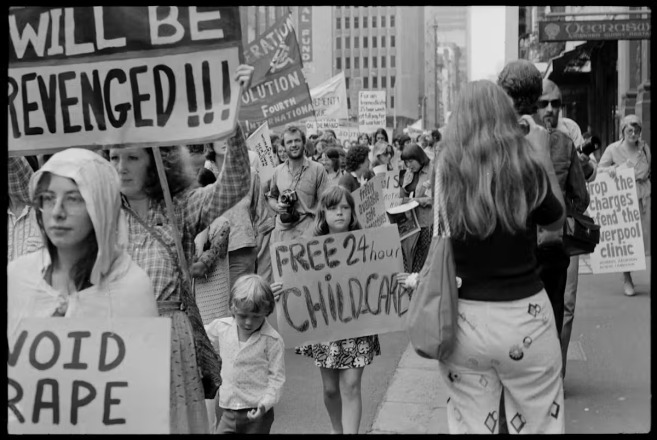
In the spring of 1970 more than 600 women met at Ruskin College, Oxford, for the first National Women’s Liberation Conference, where they established four core demands for the women’s movement, later expanded to seven. Among them was the demand for free, round-the-clock childcare for children under five.
In August 2026, Zohran Mamdani – the internet sensation Democrat Mayor for New York City – launched his ‘Parent’s Nights Out’ scheme, where the parents of 500 children were given the evening off, while their kids were fed and entertained at several of the city’s recreation centres. Of course, four hours a month is not enough to build a life outside of parenthood, and with approximately 1.7 million children living in NYC, the scheme is little more than a gimmick. But in its own, very limited way, it captures something of the spirit of the demand for 24-7 childcare.
Parenthood should not be a prison sentence. It should not mean the end of your social life, your romantic life, or your hobbies. Implicit in ‘round-the-clock childcare’ are all the things that you could be doing with your time: going out on the piss with your mates, going to the park and reading a book, joining a sports team, or sitting at home and staring at the wall – these are all perfectly good reasons for your children to be looked after by someone else.
CUT TO THE BONE
Since September 2025, working parents of under-fives have been entitled to up to 30 hours of free childcare a week for 38 weeks of the year. With most of us working more than 30 hours a week and more than 38 weeks a year, there is a large shortfall. The rest either has to be paid for, or stitched together using family and friends, if we’re lucky enough to have a network around us. Meanwhile, government funding offered to nurseries rarely covers operating costs, and parents are faced with expensive add-ons, such as charges for nappies, wipes and food, or ramped up prices for unfunded hours. In May, the government reported that 72 percent of parents are using savings to cover these costs.
Underfunded and expensive nurseries are just the tip of the iceberg. The last sixteen years have seen the closure of more than a third of children’s centres, over 800 play parks, and more than 1,200 youth clubs. This year, London Mayor Sadiq Khan has pledged to fund at least one late-night youth club in each of the 32 London boroughs. More than 130 youth clubs have been closed in the capital since 2010.
Chronic housing insecurity is having a dramatic impact on working class communities too: lack of social housing, sky-high rents, and dodgy landlords all mean that people are less and less able to put down roots. The result? Families are poorer, overworked and, most of all, isolated. Parents – mothers, in particular – have been left to struggle by themselves.
NOWHERE TO GO
But it’s not just parents who are lonely. In 1998, Blair’s government introduced the ASBO: the Anti-social Behaviour Order, used to persecute thousands of children and teenagers for ‘yobbish’ behaviour. Not long after, ‘mosquito alarms’ – devices that emit a high-pitch frequency only heard by people under the age of 25 – became part of the furniture of UK high streets, in a crude attempt to stop young people from ‘loitering’. Fast forward to austerity Britain and, with services cut to the bone and the cost of leaving the house rising by the day, children and young people have been left with nowhere to go.
Add to this the fact that, over the past few decades, parents have become more and more cautious about letting their kids out of the house unsupervised. People are less likely to know and trust their neighbours. Road deaths and violent crime have been in decline for decades, and children are safer now than they have ever been, but for reasons both good and bad, our media is full of stories about adults abusing children. People are frightened, and parent accordingly.
In his bestselling book ‘The Anxious Generation’, Jonathan Haidt lays out how ‘play-based childhoods’ have increasingly been eclipsed by ‘phone-based childhoods’, and tracks the deleterious effect this has had on young people’s mental health. Self-harm among adolescents has sky-rocketed since 2010, with the jump significantly higher for girls than for boys.
In recent years, the impact of social media has become much more widely accepted as a public health crisis. A ban on phones in schools came into force across England in July. Scotland is likely to follow suit early next year.
But limiting screen time, by whatever method, isn’t enough on its own. Just as essential, Haidt argues, is giving children time and space to play. ‘Play is the work of childhood,’ he writes, ‘and all young mammals have the same job: Wire up your brain by playing vigorously and often.’ Play needs to be face-to-face, ideally between children of mixed ages, and free – in other words, with as little input from adults as possible. And as children become teenagers and then adults, face-to-face socialising remains just as important for their development.
Fewer screens and more real-world relationships: it’s a simple recipe for a healthier society. Less simple, but just as urgent, is the need to reverse austerity (and then some) and rebuild a ‘real world’ that is actually accessible.
WHAT DO WE WANT?
So let us bring back the demand for free, round-the-clock childcare. But let’s not stop there.
We need:
• Generous parental leave. The Fire Brigades’ Union has successfully won 52 weeks full maternity pay in several fire and rescue services: a good benchmark for the rest of us. The paternity leave campaign ‘The Dad Shift’ calls for six weeks for dads. It’s a figure that has been selected, primarily, because six weeks is how long it takes for someone (with little to no complications) to recover after giving birth – in other words, it’s so dads can help look after their partners. It’s got very little to do with dads bonding with and raising their children, and it’s not enough. They need 52 weeks too.
• A shorter working week, with no loss of pay. We deserve time away from our children, if we want it – but we also deserve time with our children, and other loved ones, instead of spending (on average) a third of our lives with our noses to the grindstone. There are plenty of examples where shorter working hours have resulted in increased productivity, but even if it didn’t, we would demand it anyway.
• Accessible, high quality childcare and youth spaces, under public ownership and based in communities and workplaces. We shouldn’t have to get two buses to a nursery because we didn’t put our child’s name down six months before they were conceived. We need options, and good ones.
• Free-to-use, well-funded, publicly-owned community spaces. Not just children’s centres and libraries (although absolutely these), but neighbourhood canteens, sports facilities, arts venues, and more.
An overhaul of policing, including the abolition of ASBOs, stop and search, and other police powers that target minorities and make public spaces unsafe, in particular for young people.
The list, obviously, goes on. And if these demands seem ambitious, then good. They need to be. After decades of decline in the labour movement and the welfare state, we need an agenda that raises our horizons beyond merely taking the edges off exploitation and loneliness.
SPACE FOR JOY
In 2025, birth rates fell for the fourth consecutive year, to a 50-year low. On average, each woman will now give birth to 1.4 children, a figure down from 1.9 children in 2010, and considerably lower than the 2.4 children we heard so much about in the 1990s. One result has been a spate of hand-wringing articles in the mainstream press about the so-called ‘fertility crisis’.
The reasons why people are choosing to have fewer or no children are numerous. Some of these reasons are positive (they have better things to do, for one.) But a lot of these articles simply fail to ask the obvious questions. Is it a fertility crisis or a housing crisis? Is it a fertility crisis or a cost of living crisis? Is it the existential dread brought on by the climate crisis? Is it the fact that everything is, actually, quite shit?
We need to fight, tooth and nail, for things to be less shit. For an end to mothers struggling with their kids, alone at home, or stitching together just enough childcare so they can go back to work and give half their pay cheque to a privately-run, falling-to-pieces nursery; an end to young people feeling like the online world has more to offer than the real one; a society that gives us time and space for joy, inside and outside of our families.
Comments?We welcome replies, corrections and debate pieces. Contact us