
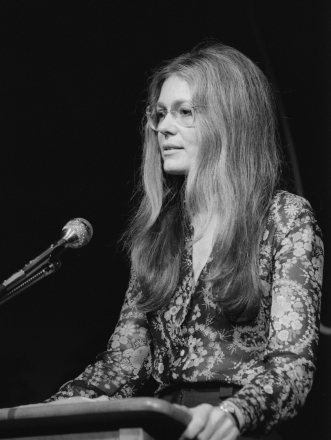
Gloria Steinem was one of the defining faces of the feminist movement. As the New York Times recently described her, she was ‘the personification of the women’s movement’ – a figure whose name and image were inseparable from the movement itself. For many, she was a crusader for reproductive rights, coining the term ‘reproductive freedom’, and a champion of women’s liberation — a legacy that will endure. Her image — beyond the iconic aviator sunglasses and long, blonde‑streaked hair — became a symbol of second‑wave feminism and its lasting influence.
Steinem died at the age of 92 at her home in New York City. She was born on March 25, 1934, in Toledo, Ohio.
Her childhood was marked by instability. After her parents’ divorce, Steinem lived permanently with her mother, whose severe mental illness left Gloria afraid to be alone with her. Her mother’s condition disrupted not only their social life but also their economic stability.
With her father largely absent and providing minimal financial support, the family’s financial situation deteriorated further as her mother struggled to keep employment. This became a formative experience for Steinem. She later understood her mother’s inability to work not as a personal failing, but as a consequence of a system built on hostility toward working women — a system that exploited them, and showed profound apathy toward women’s suffering. Her mother’s treatment was, to Steinem, an early lesson that women’s oppression is embroidered into the very fabric of society.
She graduated from Smith College, one year after the prominent feminist writer and poet Sylvia Plath. Graduating with distinction, she then spent two years in India as a Chester Bowles Asian Fellow. Her experience in India became formative. But even before that, Steinem writes in ‘My Life on the Road’ that she had an abortion just before leaving for India. While living in London at 22, she sought the help of Dr. John Sharpe. In 1957, abortion was still illegal in the UK — it would take another ten years for the law to change. The doctor, who risked his career and freedom to help a young woman, asked her to promise him two things: ‘First, you will not tell anyone my name. Second, you will do what you want to do with your life.’
Until she left for India, Steinem loathed public speaking. Only after her work there did she become the confident public speaker we know her as today. Most importantly, during her time in India — working with a direct action group tackling caste violence and religious intolerance — she familiarised herself with the Indian national independence movement, which shaped her activism thereafter. She writes in ‘My Life on the Road’:
‘If you want people to listen to you, you have to listen to them. If you hope people will change how they live, you have to know how they live. If you want people to see you, you have to sit down with them eye‑to‑eye. Most of us have a few events that divide our lives into ‘before’ and ‘after’. This was one for me.’
She understood the power of grassroots campaigns and collectivism.
After returning to the United States, she served as director of the Independent Research Service, an organisation funded by the CIA — which she claimed at the time were ‘the good guys.’ The organisation focused on encouraging non‑communist American students to attend a Soviet‑sponsored festival in Vienna to counter the Red Scare. Shortly after this period, Steinem became a freelance journalist in New York.
Her prominence skyrocketed following her exposé on the humiliating and poor working conditions of Playboy Bunnies. Her article ‘After Black Power, Women’s Liberation’ for New York magazine brought her to the forefront of second‑wave feminism and made her one of the movement’s most recognisable activists. Steinem also famously argued that economic systems must prioritise reproduction over production, stating that ‘every economics course ought to start not with production but with reproduction. It is way more important’, and that only through achieving reproductive freedom can women’s liberation be realised.
This led her, in 1972, to establish Ms. Magazine with a group of fellow feminist activists. Many predicted the magazine would fail and sell nothing. They were wrong. It sold 300,000 copies nationwide in eight days and, within weeks, gained 26,000 subscribers. The topics on the front page ranged from domestic abuse, sexual harassment at work, the socioeconomic impacts of marriage on women, and patriarchal body shame. In 1981, she put endometriosis — and the taboo surrounding it — on the front page, a topic still stigmatised in mainstream media.
That being said, many criticised her magazine endeavour and Steinem’s emergence as the chief spokesperson of the women’s liberation movement, which they argued required collective action rather than individual leadership or glamorisation. Betty Friedan, author of ‘The Feminine Mystique’, the book credited with launching second‑wave feminism, criticised Ms. Magazine and Steinem for capitalising on and profiting from the women’s movement. Friedan also accused her of attracting what she called ‘the lavender menace’ — lesbians — to the movement, and claimed Steinem came from the ‘bra‑burning, anti‑men, “politics of orgasm”’ school of feminism.
Gloria Steinem will remain one of the most influential figures of the feminist movement. However, like any individual, her record is not unblemished. Many criticised her for being a feminist who believed the state and government were establishments capable of reforming. Her involvement with the CIA will forever be seen as an act of state‑centric alignment and, for many, a disqualifying factor in viewing her as a radical activist. In 1998 she defended Bill Clinton against sexual assault allegations further entrenching the criticism regarding her activism.
Despite all of this, and despite the many disagreements people may have with Steinem, we can agree that she contributed significantly to the landscape of women’s liberation. Her contribution was flawed and, in many ways, status‑quo‑centric — but it was undeniably significant. We can also remember her quotes, such as the one that has always been my favourite: ‘The truth will set you free, but first it will piss you off’, or ‘Women have two choices. Either she is a feminist or a masochist.’
Comments?We welcome replies, corrections and debate pieces. Contact us