
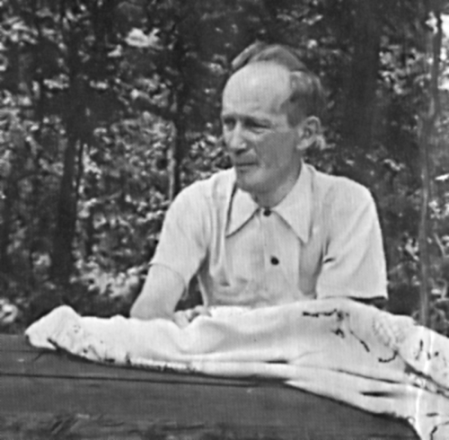
Roman Rosdolsky, a Ukrainian Marxist who had been chief theoretician of the Communist Party of Western Ukraine in the 1920s, wrote the monograph Engels and the Non-Historic Peoples, in 1948.
He had become a Trotskyist in the early 1930s, and remained a Trotskyist to his death in 1967, although in his later years, exiled in the USA (1947-67) he was not active day-to-day. He was close to the Orthodox Trotskyist Ernest Mandel, although Rosdolsky came to reject the Orthodox Trotskyist scheme naming the Stalinist countries "degenerated and deformed workers' states". He is best known for The Making of Marx's Capital, his monumental analysis of Marx's 1857-8 Grundrisse (only a few copies of which existed in the world when Rosdolsky did his work on it), published in 1968 in German, 1976 in French, 1977 in English.
Rosdolsky survived Auschwitz, when he was sent for aiding Jews, and witnessed Stalin's secret police liquidate his comrades. The book is dedicated "to the memory of Mykola Skrypnyk, Oleksander Shumsky and Karlo Maksymovych, victims of Stalin's terror in Ukraine."
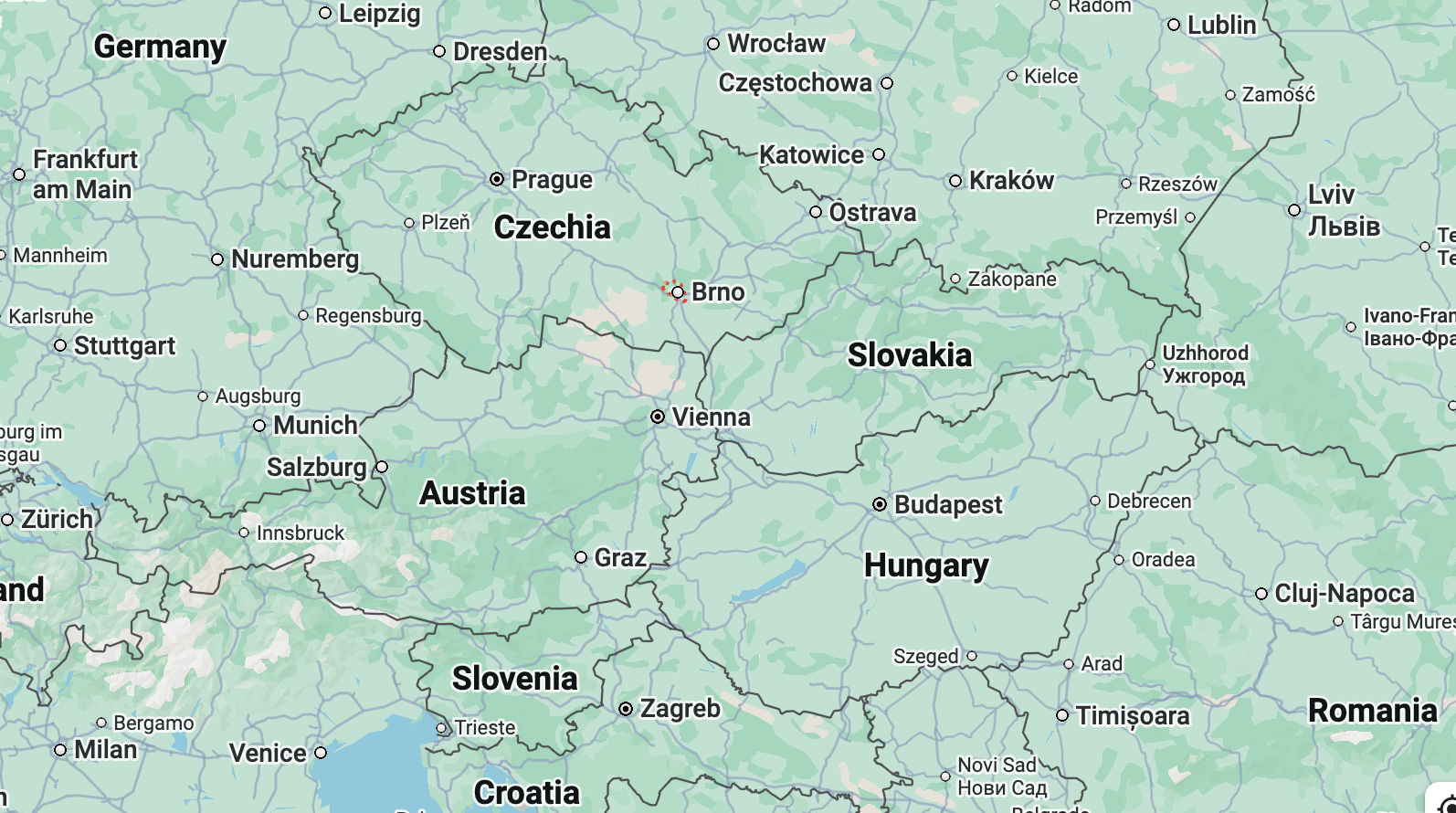
The region with today's borders
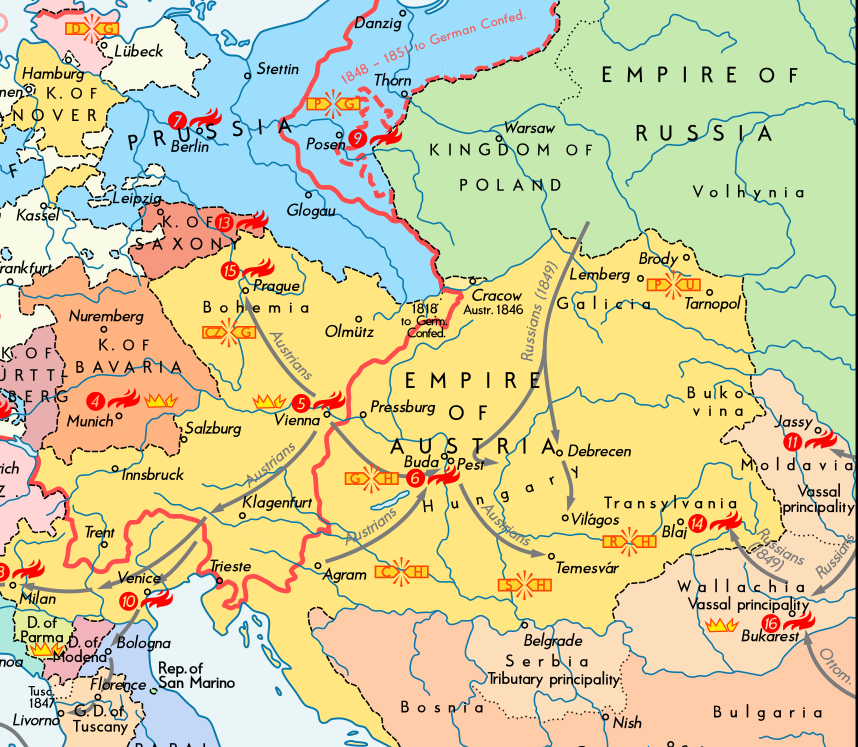
The region with the borders of 1848. The "kingdom of Poland" was a section of Poland ruled by Russia; other Polish-peopled areas appear on this map as parts of Prussia or of the Austrian (Habsburg) empire. The red border is that of the German Confederation, the alliance then of the many German states, all small apart from Prussia and Austria, which both ruled large non-German areas. Lemberg is today's Lviv; Pressburg, today's Bratislava.
During the revolution of 1848–49, Marx and Engels, then the editor-in-chief and a leading writer of the Neue Rheinische Zeitung (NRZ), had characterised most of the Slavic peoples of the Habsburg monarchy — Czechs, Slovaks, Slovenes, Croats, Serbs, Ukrainians (Ruthenians), etc. — together with the Austrian and Hungarian Romanians, as "nonhistoric": peoples who, in Rosdolsky's summary of Engels's usage, "were unable to form a strong state of their own in the past and therefore lacked... the power to achieve national independence in the future."
Only the Poles escaped this verdict. (The Poles had had a sizeable state for centuries before it was carved up by Russia, Prussia, and Austria in three partitions, starting in 1772). The rhetoric deployed against the rest was frequently savage. In his January 1849 article, The Magyar Struggle, he wrote:
"But at the first victorious uprising of the French proletariat... the Austrian Germans and the Magyars will gain their freedom and take a bloody revenge on the Slav barbarians. The general war which will then break out will scatter this Slav Sonderbund [alliance, named after a federation of reactionary Catholic cantons defeated in a civil war in Switzerland in 1847], and annihilate all these small pig-headed nations even to their very names. The next world war will not only cause reactionary classes and dynasties to disappear from the face of the earth, but also entire reactionary peoples. And that too is an advance."
Rosdolsky points out that by "annihilation" of nations Engels did not mean what that would come to mean in the 20th century, but the thorough political defeat of their nationalist leaders and the subsequent assimilation of the mass of the people into the dominant (German, Magyar, Polish, etc.) nations. Even so, the brutal language is out of tune with the basic ideas of Marx and Engels, and the "false prognosis" of inevitable assimilation has been, as Rosdolsky says, "ruthlessly denied by the subsequent course of history".
The work finally appeared in 1964 in German, in the Archiv für Sozialgeschichte. Its English translation by John-Paul Himka came out only in 1986, and in French (by Gérard Billy) only in 2018, though Ernest Mandel (in Quatrième Internationale, translated in Intercontinental Press) had given appreciative summary of the work at the time of Rosdolsky's death in 1968.
One correspondent, writing in 1980 to discourage the translation, warned that "the work as it stands could (and certainly would) be used by the opportunists to attack Marx-Engels... [and] can serve only to create confusion in the anti-imperialist movement."
Rosdolsky's 1948 text was not his first engagement with this material. In 1929, he submitted a doctoral dissertation titled The Problem of the Nonhistoric Peoples in K. Marx and Fr. Engels. That dissertation had defended Engels's position as materialist and historically vindicated. Its "whole sense," Rosdolsky said, rested on the claim that even though the prognosis of the Austrian Slavs' "inevitable national demise... was not confirmed by history," this did not mean Marx and Engels's 1848–49 politics "rested on an error."
That dissertation excluded the entire question of peasant class conflict from consideration, a central theme of this work.
In Himka's introduction, the 1948 monograph functions as a deliberate "antithesis" to that earlier "thesis". Whole passages from the 1929 text reappear in 1948 "with Rosdolsky's appraisal almost completely reversed." What produced this reversal? Through the 1930s, Rosdolsky "rummaged daily" in Viennese archives and later worked under Franciszek Bujak on Galician serfdom, gaining a deeper appreciation of the class antagonisms that dogged the Austrian revolution. Rosdolsky's own experience was also crucial. Between 1929 and 1948, Rosdolsky had survived both Stalinism and Fascism, and become a Trotskyist. The dedication to Stalin's Ukrainian victims and the book's closing appendix on the NRZ's antisemitism underscore the text's context of racist brutality.
Rosdolsky's argument unfolds on two interlocking tracks. Empirically, he demonstrates that the standard defence of Engels — that his hostility to the Austrian Slavs merely tracked their observably counter-revolutionary conduct — is false, or at best what he calls "only a legend."
The NRZ condemned peoples such as the Ukrainians as reactionary "wreckage of peoples" from the very outset of the revolution, well before any counter-revolutionary behaviour had occurred, and did so largely by uncritical reporting supplied by Polish and Hungarian noble correspondents.
Rosdolsky argues that this reflects something more than sloppy journalism: it reflects Marx and Engels's abandonment, at that time and on this subject, of a rigorous class analysis. They were confronted with the awkward fact that their sole practical revolutionary allies in East Central Europe — the Polish and Hungarian nobilities — were themselves the oppressors of peasants belonging to the "non-historic" nationalities. These "noble" classes were relatively large, included both magnates and people who were economically scarcely well-off farmers, and were the main "national" class, with connections and collective awareness uniting them in a common language and culture. The wage-working class scarcely existed in the region at that time.
Marx and Engels drew on their Hegelian intellectual formation and revived Hegel's category of "nonhistoric peoples" (geschichtslose Völker) to resolve the contradiction. As Rosdolsky puts it, this was something "exoteric" to their materialist method. This resulted in a skewed approach to the question of national self-determination — a skewed approach that abandoned historical materialism. If they had applied their now-established method, it would have produced politically inconvenient conclusions about their allies.
The Czechs
Rosdolsky opens with the Czechs, the most economically and culturally developed of the "nonhistoric" nations. He quotes from Engels's article of 17 June 1848 on the Prague uprising:
"A new Poznań bloodbath is being prepared in Bohemia... However the rising may end, a war of annihilation of the Germans against the Czechs is now the only possible solution."
That same article insists that "a nation which has allowed itself to be used throughout its history as an instrument for oppressing all other nations must first prove that it has really become revolutionary," and asks: "are the Czechs at fault for their unwillingness to attach themselves to a nation which oppresses and ill-treats other nations while freeing itself?"
Rosdolsky calls this "a remarkable, curious article," one containing "on the one hand, a glowing confession of internationalism... but on the other hand... the conviction that the victory of the revolution itself will end with the oppression of the Czechs."
"[W]hat sort of 'freedom' was being proclaimed for the Czech people when they were only allowed the choice of going under or living together with the Germans in a German state? Are not these glaring contradictions?"
Rosdolsky traces this incoherence to the region's class structure: the German bourgeoisie of Prague and Brno was economically integrated into the life of the area to the point that "losing 'national proprietorship' in the Slavic provinces was absolutely unthinkable to this bourgeoisie." Although Prague may have been majority Czech-speaking by 1848 (the city's "official language" was still German), Rosdolsky holds that the Czech nation was not yet strong and developed enough for its own nation-state. If such a state had somehow been formed it "could all too easily fall prey to Tsarism and become its 'outpost'." The wise democratic policy was "guaranteeing wide national autonomy and granting the Slavs full linguistic, cultural, and political rights".
As things were, however, a genuine compromise on the model of František Palacký's [Czech revolutionary] autonomist programme was "just as utopian" as later federalist schemes. Rosdolsky cannot see that Engels could identify a force that "could have moved the German bourgeoisie to abandon voluntarily its monopolistic position"
Rather than tackle the class dynamics, and although in its earlier issues it supported Czech agitation, the NRZ came to defer to realpolitik and wrote off the Czechs as having no history and destined for inevitable defeat or even suppression.
The paper's tone shifted when Czech leaders sided with Habsburg absolutism following the October 1848 uprising in Vienna. Its Viennese correspondent, Eduard Müller-Tellering — introduced by Rosdolsky as a figure we will "later get to know... also as an obtuse and repulsive anti-Semite" — was an Austrian chauvinist: "the base Czech and Ruthenian dogs," "the stupidest Slavic asses," "You Czech dogs! The tricky Gypsies [i.e., Czechs]." Rosdolsky does not excuse this language: "The mode of expression of the Neue Rheinische Zeitung interests us not on account of its 'strong language,' but rather on account of the intellectual and emotional confusion revealed in this strong language."
"Hussitism", an insult that the Nazis had levelled at the Czechs, was part of the vocabulary of German Catholic feudal reaction. It is against the principles of consistent democracy to proclaim a "'war of annihilation' against 'entire reactionary peoples' (as such)."
Also damning, for Rosdolsky, is the NRZ's conduct during the Vienna Reichstag's language debate of September 1848. When Czech deputy František Rieger demanded that non-German deputies be permitted to speak and receive translations in their own language(s), the paper mocked the proposal: "The Reichstag will become a translating institution, a Babel-mixing of tongues, which will result in the Reichstag's dissolution. Finis Austriae."
Rosdolsky draws a parallel to the French Jacobins' campaign against regional patois, quoting Barère's 1794 declaration that "federalism and superstition speak Breton; emigration and hatred of the Republic speak German... Let us break these instruments of harm and error" — and observes that "every time, unfortunately, [the 'language of freedom'] reveals itself as a counterfeit 'language of freedom.'" Against this he sets the actual voice of the Ukrainian peasant deputy Iosyf Savka, who pleaded in broken German: "Who is to blame that in Galicia the peasant does not speak German? Just the lords... I beg that the high chamber itself understand why we [peasants] have no one who knows the German language." Savka was, Rosdolsky notes, soon removed from the chamber "as the Polish democratic deputies urged" and "that the Neue Rheinische Zeitung... did not take the side of Savka... can certainly not be entered as a 'plus' in its record of revolutionary activity."
Those peasants had not set out to find themselves in the counter-revolutionary camp. The condition of their support for the revolution was land reform. That the revolutionary aristocracy refused the demand saw those same peasants driven, even reluctantly, back into the emperor's camp.
The South Slavs
The South Slav nationalities, Serbs, Croats, Slovenes, received harsher treatment than the Czechs, even though the Croats had their own compact area where they were the clear majority, and Zagreb was Croat-speaking. They were dismissed as reactionary before any of their conduct could be demonstrably proved to be counter-revolutionary. Rosdolsky argues the NRZ here functioned largely as "the mouthpiece of its allies, Hungarian and Polish aristocratic-bourgeois democracy, whose prejudices and illusions it shared."
Marx's own judgment after the fall of Vienna captures the pattern: "Croats, pandours, Czechs, serežani and similar rabble throttled German liberty in Vienna, and the tsar is now omnipresent in Europe."
The Slovaks and Romanians reveal a further inconsistency: the same nationality could be praised or condemned depending on which neighbouring nobility it opposed. "Since the Neue Rheinische Zeitung considered a people's counter-revolutionary behaviour to be proof of its incapacity to exist," Rosdolsky writes, "the one and the same people — the Romanians — figured in the paper's columns, depending on habitat, now as a long-decayed nation, entirely lacking in active historical forces, and then as a nationality whose freedom and independence had to be defended." Transylvanian Romanians, opposing the Hungarians, were reactionary; Romanians of the Danubian Principalities, opposing Russia, were revolutionary allies — an inconsistency explicable only by which side's nobility the NRZ happened to be allied with.
Engels's treatment of the Slovaks shows similar problems: in one 1849 article they are "impervious to any national fanaticism" and pro-Hungarian; another report claims they were being incited toward "pan-Slavic hatred for the Magyars." Rosdolsky notes this "corresponded as little to the truth" as other fabricated Galician reporting.
The Ukrainians
Rosdolsky devotes his longest chapter to the Ukrainian (Ruthenian) case.
He describes the Galician Ruthenians of 1848 by quoting Maximilian Bach: "millions of rural proletarians, economically and culturally oppressed for centuries, without even the rudiments of a class formation... without its own culture, removed from any culture whatsoever." Their nascent national consciousness rested almost entirely on the Greek Catholic clergy, since the peasant masses "felt Ruthenian... only because the landlords and their creatures were Poles." Rosdolsky invokes Otto Bauer approvingly here: the national contradiction was "merely a phenomenal form of the social contradiction; national hatred was only class hatred transformed."
But the centrepiece of this chapter is Rosdolsky's dismantling of what he calls "the Polish nobility's version of the origins of the Galician butchery of 1846".
In that notorious massacre, peasants attacked and killed Polish landlords who had been organising an insurrection against Austria. The nobility's own explanation blamed Austrian intrigue: Metternich [German statesman in the Austrian Empire], they claimed, had "set the unsuspecting peasants against their landlords." But since the massacre occurred in West Galicia, the ethnically Polish part of the province, this "spontaneously generated legend" gained a new explanation for the ears of foreign democrats. They were told the killers were not Polish peasants at all but "nationally and religiously fanaticised Ruthenian peasants," even though the Ruthenians inhabited the east, not the west of the territory.
Yet when foreign democrats asked whether Poland contained "several nationalities," the reply was that Ruthenians were "when you examine the matter closely — Poles as much as we are". Not only their revolt, but their very nationality, was merely a demagogic invention of Metternich in line with his divide-and-rule policy.
Engels parrotted this fabrication in The Magyar Struggle he wrote that "Metternich suppressed the democratic Polish movement, which had begun in the interests of the peasants, by using the religious and national fanaticism of the Ruthenian peasants themselves," and elsewhere claimed the Ruthenians "first learned by the agency of Metternich that the Poles were their oppressors… as if the Poles themselves had not been oppressed just as much as the Ruthenians."
Rosdolsky calls both arguments "the most unadulterated sophistry," and traces how the legend passed from Engels to Kautsky, Otto Bauer, and the Stalinist historian Steklov. That chain of transmission shows how a single piece of noble propaganda could become the dominant narrative through decades of subsequent understanding.
Rosdolsky also challenges a fabricated NRZ anecdote about the peasant leader Jakub Szela, who had actually led the 1846 killings. A report claimed Szela had petitioned for a Reichstag seat, jealous of the elected Ukrainian peasant deputy Lukiian Kobylytsia — whom the same report falsely accused of having tortured and mutilated local officials. Rosdolsky establishes from Habsburg archival records that "not a single word... except for the names of the two peasants, is true": Szela never ran for the Reichstag, and Kobylytsia's alleged crimes are wholly invented. "The fiction," Rosdolsky concludes, "had an extremely transparent purpose: to compromise the peasant deputies to the Reichstag... and thus to create a favourable atmosphere for their expulsion from parliament."
The genuinely radical voice of Ukrainian peasant deputies survives in the record Rosdolsky recovers, as in Ivan Kapushchak's Reichstag speech insisting landlords, not peasants, owed compensation for feudal servitude: "The whips they used on our bent bodies — yes! this we can leave them as compensation."
Rosdolsky closes the chapter by quoting Engels's own later self-criticism, in an 1853 letter to Joseph Weydemeyer: "As to the former Polish provinces on this side of the Dvina and Dnieper [Engels seems to mean the eastern part of what was then Poland], I want to hear nothing more of them, knowing as I do that the peasants there are all Ukrainians, only the aristocracy and some of the people in the towns being Polish, and that to the peasant there, as in Ukrainian Galicia [area under Habsburg rule] in 1846, the restoration of Poland is synonymous with the restoration of the old ruling aristocracy, its powers unimpaired." Rosdolsky asks: "Could one wish for a more cogent critique of the Neue Rheinische Zeitung's Ukrainian-Polish politics than this self-criticism from Engels's own pen?"
The Theory of "Nonhistoric" Peoples
The second part of Rosdolsky's work asks how and why Engels could reject a consistent democracy for all peoples.
Rosdolsky starts with Hegel. World history is the progressive self-realisation of Spirit through peoples capable of forming great independent states; peoples lacking this capacity are destined for absorption by more "historic" neighbours. Hegel's scheme surely had a large element of national conceit, because he saw the "Germanic world", expressed in the Prussian state and Lutheran Christianity, as the acme of progressive development (which, he says, started in Asia).
For Engels, the idea is that the development of the productive forces is driven by class struggle, not by a World Spirit which expressed itself through some peoples but not others. Yet Rosdolsky demonstrates that Engels, in his 1848–49 journalism, relies on something like a version of Hegel's scheme, whereas a materialist class analysis would explode it.
Rosdolsky argues that this was not sloppiness by Engels but reflected bias toward the allies of the German revolution. Opposition to Habsburg and Tsarist absolutism came from the Polish and Hungarian nobilities, the direct oppressors of Ukrainian, Slovak, Croatian, Serbian, and Romanian peasants.
Engels wants to ignore the fact that the reactionary peasant nationalism represented a legitimate protest against their own exploitation by the revolution's allies.
Engels does not want to abandon the alliance, with no political alternative available, or subject that alliance or the journalistic contributions of others to uncomfortable scrutiny.
A second factor is the impasse of Marx's and Engels's programme in 1848. They aimed for a Europe-wide democratic revolution, summed up in the last issue of the NRZ. "If Hungary were independent, Poland restored, German Austria turned into the revolutionary focus of Germany, with Lombardy and Italy winning independence -- these plans, if carried out, would wreck the entire East European political system: Austria would disappear, Prussia would disintegrate and Russia would be forced back to the borders of Asia."
The "programme ran up against the anemia and class bigotry of the ruling classes of the 'historic' [and in any case, most active in 1848] nations, the German bourgeoisie and the Hungarian and Polish nobility". Later (as Rodolsky records) Marx would write that "the whole thing in Germany [which then still meant: all the more-or-less German lands] will depend on the possibility of backing the proletarian revolution by some second edition of the Peasant War".
But the NRZ had neither a clear programme for the full liberation of the central and East European peasants from the feudal oppression which they still suffered, sometimes at medieval levels, nor an agency to lead on any such programme. Worse, it sometimes deceived itself by saying that the Hungarian and Polish nobility had already emancipated the peasants. Engels wrote that "Hungary is the only country in which... feudal burdens on the peasants have legally and in fact totally ceased to exist". He was, Rosdolsky says, "simply in error". In "all of Austria" (.e. the Habsburg empire, including Hungary but also e.g. Croatia) "medieval feudal duties" (vanished centuries before in e.g. England, and already scarcely remunerative in the east) "had factually ended in 1848 and... legally... in September of that year", but much remained "burdening the peasantry... with an onerous compensation for the landlord, being mortally afraid of any change in landed property, and leaving the very important question of the peasants' right to use forests and pastures to the discretion of absolutism and the feudal nobility..."
So, the 1848 revolutions were defeated, and would have been defeated whatever the NRZ had said and done. But Marx and Engels, as revolutionaries, would refuse to admit defeat until late 1850. When the NRZ was forced to cease publication, its last issue declared the coming agenda as: "Revolutionary rising of the French working class, world war... And in the East, a revolutionary army made up of fighters of all nationalities already confronts the alliance of the old Europe represented by the Russian army, while from Paris comes the threat of a 'red republic'."
Hardly "all nationalities", as we have seen: the supposedly "counter-revolutionary peoples" could be dismissed because they were too weak, and had to be dismissed because they could not possibly to be rallied to the hoped-for leaders of the anti-Tsarist, anti-Habsburg revolutionary cause, "the German bourgeoisie and the Hungarian and Polish nobility".
Rosdolsky does not accuse Marx and Engels of an individual moral failing. He insists that "the immense difficulties that stood in the way of the solution of the national question in the revolution of 1848" were real and severe: the class position of the German bourgeoisie in Austria's lands made a compromise with the oppressed nationalities extraordinarily difficult, since national privilege and class privilege were fused for that bourgeoisie in ways that made voluntary renunciation nearly unthinkable. His argument is not that Marx and Engels faced a simple problem that they got wrong because they were unthinking, but that they faced a genuinely intractable contradiction and attempted to sidestep it rather than answer it. And that meant abandoning materialism rather than seeking clarity in the limits of what their analysis, as then constituted, could resolve.
The Neue Rheinische Zeitung and the Jews
Rosdolsky closes with an examination of the NRZ's troubling relationship to antisemitism, embodied above all in Müller-Tellering's repeated conflation of "Germans and Jews" into a single reactionary economic bloc of "profit-mad" exploiters in Prague and Poznań. His articles mark a definite low point in the NRZ. He described "the Germans and the Jews" as having "assumed the same role in Bohemia that their comrades have already played with such success in Poznań," a "swarm of locusts" whose "peaceable existence of usury" the March revolution had disturbed.
Rosdolsky says, as with the "nonhistoric peoples", that the same underlying failure of class analysis is here directed at Jews rather than Slavs and composed in the shadow of, in his own words, "the death of millions of Jews in the German gas chambers," and by an author who had himself been imprisoned in Auschwitz for aiding Jews.
In his introduction, Himka says that Rosdolsky aimed "to clear the way for a correct Marxist understanding of the national question by correcting errors in the Marxist tradition, indeed at the very source of that tradition." Marxists should read and learn from Rosdolsky. §
Comments?We welcome replies, corrections and debate pieces. Contact us