
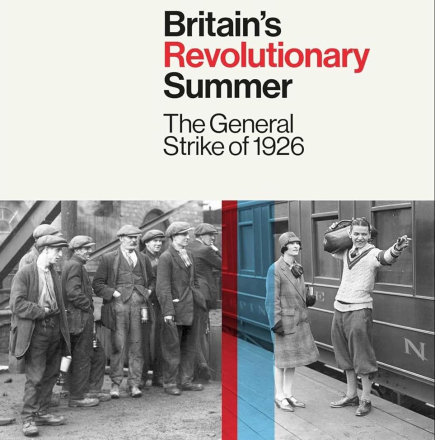
Review of Edd Mustill, Britain's Revolutionary Summer: The General Strike of 1926
Edd Mustill has written an accessible history of the General Strike of 1926, aimed at the general reader but with plenty to interest those already well-informed about the dispute.
The opening chapter of Mustill’s book places the strike in a vital context. Coal, and therefore coal-mining, was a crucial power source for the British economy, powering the railways, the metal industry and the Navy. It was, therefore, also "the first requisite of Empire".
Propelled by telling statistics – "on average a miner was killed every six hours" – and vital anecdotes, such as that of the future miners’ leader Arthur Cook carrying a dead colleague’s body out of the pit on his first day in the mines, Mustill’s account brings home the dangers of the industry and the conditions facing the miners.
He also traces the development of coal-mining communities, and with them, the growth of mining trade unionism throughout the nineteenth century, culminating in the foundation of the Mining Federation of Great Britian (MFGB) in 1888.
The MFGB was radicalised during the "Great Unrest" period, 1910-1914, leading to the emergence of a new layer of activists and leaders, influenced by syndicalism. From amongst this ferment emerged Cook, who would lead the MFGB through the strike.
As Mustill recounts, the General Strike had its roots in ruling-class attempts to unwind the statification of the industrial economy during the First World War and restore laissez-faire and private profit-making.
The working-class had emerged from the war, years, however, in a position of organisational strength. The 40-hour week was won in Clydeside in 1919, as was a 30% wage increase for 300,000 Lancashire cotton operatives. In 1920, working-class assertion in the "Hands off Russia" campaign averted British intervention against the victorious Bolshevik revolution.
By 1921, the position was in reverse and the employers were on the offensive. Unemployment reached two million and union membership fell by over two million by 1923.
1923 saw a short-lived recovery, which saw a rise in morale and a halt to the decline in union membership. Added to this, the disappointment of the first Labour government in 1924 encouraged workers to rely on trade union struggle.
The new Tory government of Stanley Baldwin was returned in November 1924 with a huge majority. It decided to return to the gold standard and press home employers’ demands for wage cuts and longer hours to restore profitability.
As the largest industry in Britain, the miners were in the firing line for the bosses’ offensive. The mine-owners had locked the miners out in 1921, forcing them back on worse terms when they were abandoned by the transport and rail unions on “Black Friday”, 15 April 1921. In 1925, they returned again, seeking the wage cuts, the abolition of the national minimum wage and an end to national collective bargaining.
A TUC threat to impose an embargo on the movement of coal on “Red Friday”, 30 July 2025, was sufficient to force the government to announce a 9-month subsidy to the industry, and to establish a Royal Commission (the Samul Commission) to draw up proposals for the future.
The unions, however, had made little preparation to actually enforce an embargo. In the nine-month gap, the government lost no time in making preparations for what it saw as an inevitable conflict. Plans were made for strike-breaking on a national scale, including the recruitment of volunteers.
When the Samuel Commission reported, the government insisted the MFGB accept the principle of wage cuts before discussing the general organisation of the industry. The scene was set for a conflict for which the government were prepared and the TUC had always hoped to avoid.
As Mustill argues, the TUC insisted on restricting the scope of the dispute to a limited industrial dispute over terms and conditions in the mining industry. The government and the press, however, saw it as an attempt to overthrow the constitution.
While the TUC genuinely had no intention of such a thing, and the government’s claims were dishonest, there is one sense in which the ruling-class had a point. As Trotsky wrote, general strikes have a logic of their own and, after a certain point, force the issue of who ultimately rules in society: “The general strike is one of the most acute forms of class war. It is one step from the general strike to armed insurrection… If carried through to the end, the general strike brings the revolutionary class up against the task of organising a new state power… A real victory for the general strike can only be found in the conquest of power by the proletariat.”
That was something the TUC were determined not to face up to. The TUC and its various sub-committees also jealously guarded their power, limiting local initiatives. An example is the use of the press during the strike. The Government published the British Gazette, giving its account of the strike. The TUC responded with the British Worker, but the extension of the strike to the printing of labour movement and socialist publications, such as the ILP’s New Leader, deprived the movement the ability to discuss strategy and hold its leaders to account. Local strike bulletins were published, however, and many thankfully continued despite TUC demands to cease.
By contrast, working-class enthusiasm for the strike was unprecedently high with millions of workers rallying behind the miners. Many trades councils co-opted labour movement political organisations and began to resemble "Councils of Action", which enforced the strike locally.
As Mustill also notes, the "general strike was not a general strike, or so the General Council said", preferring the term "national strike", as the TUC had offered to keep food supplies moving. The TUC strategy also involved sending workers out in waves – the “first line” included transport, print, metal and heavy chemical, and construction with the “second line” involving engineering, chemicals and related industries. This was a source of confusion to many workers, leading to inter-union tensions at a local level as members managed the tactical practicalities of the TUC’s instructions.
Mustill provides useful information, based on local sources about the interplay between the TUC General Council and local trades councils and Councils for Actions. Paradoxically, the demand for "All power to the TUC" and for solidarity and centralisation tended to concentrate power on those leaders who wanted nothing less than to settle the strike.
This is ultimately what happened. As Mustill argues, the TUC ultimately "had never really shared the miners’ position of absolute opposition to wage cuts." On 11 May, however, a final “settlement”, which still included wage cuts, was drawn up between Sir Herbert Samuel and the TUC Negotiating Committee. The TUC accepted it over the heads of the miners, to whom it was put with an ultimatum.
The TUC had surrendered at a time when there were many more workers out than on the first days of the strike. Worse, it had not secured any guarantees against victimisation and the replacement of striking workers with scabs. This led to what Mustill highlights as the "second general strike" in which unions fought a rearguard action to secure the return of their members on less unfavourable terms.
The miners, however, had to fight on alone for seven months before finally returning to work on 1921 wage levels, with the loss of national collective bargaining.
Mustill also briefly addresses the issue of the revolutionary left, namely the Communist Party of Great Britain (CPGB). He quotes party historian James Klugmann who, writing in 1969, echoed the contemporary analysis of J. T. Murphy, namely that the CPGB was too weak to ultimately influence the course of the strike and had to make do with raising consciousness and providing support.
At the same time, Mustill highlights Trotsky’s criticism of the Russian bureaucracy’s attempt to force diplomatic relations with the "left" leaders on the TUC, through the Anglo-Russian Trade Union Committee. This, Mustill writes, "unavoidably blunted the revolutionary zeal and agitation of the Communist Party."
The book far from neglects the wider politics of the strike but its focus remains on workers’ self-organisation and assertion.
Mustill closes with a quote from Birmingham socialist J Stuart Barr, who noted after the strike that: “A lot has been said in the past of the need for the workers having faith in their leaders; I would humbly suggest that if the strike taught us nothing else, it certainly taught us that it is just as important for the leaders to have faith in the workers.”
It is this attitude, “and the confidence and organisation to put it into practice, that need to be rediscovered.” §
Comments?We welcome replies, corrections and debate pieces. Contact us