
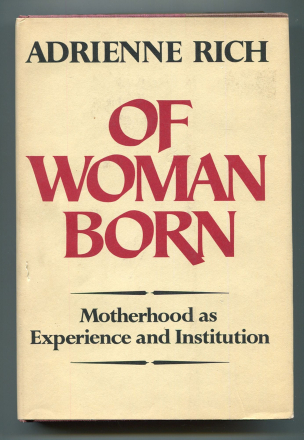
In Of Woman Born, originally published in 1976, and being discussed by the London Socialist Feminist Book Club on 19 April, influential poet and feminist Adrienne Rich examines motherhood as an institution.
She looks at her and other’s experience of mothering, both determined by and distinct from the institution of motherhood as it is imposed on all women everywhere. The book argues the political institution of motherhood is bound up with devaluation of women in other spheres and the pressures of women to validate themselves in maternity. Whether you are a mother or not, as a woman you are socially defined by motherhood.
In the early seventies little feminist writing centred on motherhood. Rich is credited with introducing a new approach, a blend of memoir, academic writing and political manifesto, now common in popular feminist writing. Rich’s writing is skilled and flows well, making the long book an enjoyable read.
Rich, who died in 2012, was a radical feminist (as distinct from “socialist feminist” or “liberal feminist”), arguing that motherhood, like the rest of the society, is shaped by patriarchy. Patriarchy, she explains, “is the power of the fathers: a familial-social, ideological, political system in which men, by force, direct pressure, or through ritual, tradition, law, and language, customs, etiquette, education and the division of labour, determine what part women shall or shall not play and in which the female is everywhere subsumed under the male.”
Patriarchy
However Rich’s concept of patriarchy is historically rooted in relationship to other social relations. The new economic relations established with each mode of production exert pressure on other social relations, making some obsolete, remoulding others. The book notes the birth of capitalism changed the experience of motherhood — work was moved from the home to industrial settings, isolating mothers or forcing them to endure motherhood in conditions unsuited to it (in factories etc).
Motherhood changed through capitalism. Rich described how household commodities, washing machines, vacuum cleaners, and the like, had (in the USA, at least) reduced the physical burden of domestic labour, but came with a change toward a more private culture of household work which made mothers more lonely. She contrasts the collective mothering of factory towns to the segregated existence of the suburban mums of 1950s America.
I read the 1986 reprint of the book, and in the introduction there she states she would no longer end the book as in 1976: “the repossession by women of our bodies will bring far more essential change to human society than the seizing of the means of production by workers”. In the intervening decades her politics had come to see the fight for women’s personhood was “hand in hand” with fight against class exploitation.
The book’s criticism of medicine is striking and unbalanced. The history of medical childbirth is harrowing, but she dismisses the potential for medicine to reduce pain and risk in labour. The bad side-effects of the contraceptive pill are amplified, and its potential to improve women’s lives underplayed.
Rich’s reputation has been damaged because she edited Janice Raymond’s 1979 book The Transsexual Empire: The Making of the She-Male, which is widely recognized as a foundational trans-misogynistic text. We cannot know whether Rich regretted this. She certainly made no public repudiation, though she ended on opposite sides to Raymond in the “sex wars”.
There is only one quote from Rich in Raymond’s book: “men who have given up the supposed ultimate possession of manhood in a patriarchal society by self-castration”. This is supposed by many to mean trans women, though in her writing Rich uses castration not so much in the medical sense but as giving up or removal of male patriarchal power and privilege. She uses it to describe a potential political and social project of throwing off or deconstructing patriarchy.
Men
Unlike many rad fems of the era, she saw a place for men and talked warmly about her hopes and fears for her own boy children. But involving men in feminism, she stated, must also involve stopping praising them for choosing to share in the work of childcare.
Rich spoke of a constant process “re-vision” of her life, ideas and work. She defined the concept, in a 1971 speech, as “the act of looking back, of seeing with fresh eyes, of entertaining an old text from a new critical direction.”
She had an extraordinary life, good and bad. Her father was controlling and abusive, her husband killed himself after she left him, her life was shaped by ill-health and disability. She transformed from Jewish child prodigy, to fifties housewife and renowned poet, to loving angry mother and groundbreaking feminist.
In many ways her experience of motherhood was exceptional. In “the embodiment of rage, of tragedy, of the overcharged energy of love, of inventive desperation” she was shockingly normal.
Comments?We welcome replies, corrections and debate pieces. Contact us