
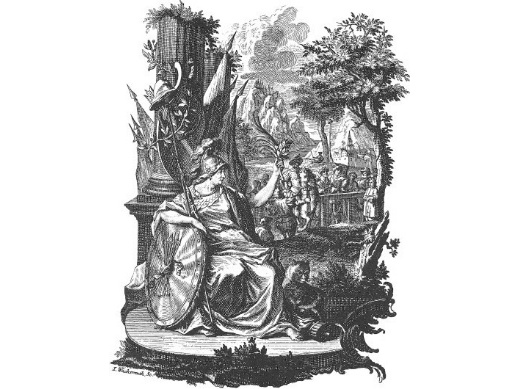
Pic: from Denis Diderot’s Encyclopédie
Not before time, let’s look at the word that greets every reader of Solidarity whenever they purchase a copy of this paper. It’s there in the masthead and is part of the furniture of the front page.
This is a word with a rich and noble history. Although its general meaning is clear, there are some variations and it has been a debating point for philosophers for many years. More importantly, over the years people have organised, laboured and died fighting for liberty.
Liberty, the word and its various manifestations, is all around us: migrants arriving in the USA from the Old World have been met since 1886 by the Statue of Liberty; in Ireland 1798 was the "Year of Liberty"; the French revolutionaries of 1790 rallied to the cry of "Liberté, Egalité, Fraternité"; a political prisoner on release regains "their liberty"; one of the most famous works of the Enlightenment was John Stuart Mill’s On Liberty; on the barricades, Liberty leads the people in the famous painting by Eugene Delacroix; in the Abba song Fernando goes to fight for liberty; the former National Council for Civil Liberties (NCCL) changed its name in 1989 and is now simply called Liberty.
Those are just a few examples. The earliest use of liberty (in English), according to the OED, can be found in Wycliffe’s translation of the Bible in 1384, although its origins lie with French (liberté) and Latin (libertas). Anglo-Norman usage can be traced back to the late 12th century, leading to the word lybarte in Middle English.
Although it usually had a positive connotation Shakespeare gives us a negative slant in Much Ado About Nothing where he writes about “… a liberal villaine who hath confest his vile encounters”. The idea of liberty comes strongly to the fore during the Enlightenment, with the writings of John Locke (1632-1704) and others. It took time to become established (with still some way to go) and Locke had to publish some of his works anonymously to avoid retribution. The spirit of the time is captured in this illustration from Denis Diderot’s Encyclopédie.
An illustration from one of the great documents of the Enlightenment: Denis Diderot’s Encyclopédie. The artist was Swiss and this accounts for the inclusion of William Tell shooting the apple off his son’s head in the background. The accompanying article was written by Louis de Jaurcourt, also Swiss, who contributed many essays to the enormous Encyclopédie. In the foreground Liberty, as was the convention at the time, is portrayed as a woman. She is waving what is probably an olive branch. At her feet is an animal (a bear cub or a very ugly cat?) sitting on a bundle of Fasces (sticks held firmly together in a cylindrical shape) originally of Roman origin depicting magisterial power and authority. It later came to represent strength through unity but in the 20th Century was appropriated by the Italian fascist movement. The hat on the end of a long stick held in her right hand is a mocking reference to the action of Hermann Grisler (sometimes Gessler) the tyrannical Governor of the Uri Canton in Switzerland. He arrogantly placed his hat on a stick in the town square of Altorff and ordered the inhabitants to salute it. A certain William Tell refused.
Despite the writings of Locke, Mill, Rousseau, Diderot and others, the notion of liberty was not universally accepted and the executions by guillotine of numerous French aristocrats and the fratricide among the revolutionaries (the execution of Danton for example) turned some, notably Edmund Burke, against the ideals of the Revolution although he supported the Americans in the War of Independence. In 1790 he wrote his most famous work Reflections on the Revolution in France. Thomas Paine argued against Burke in his The Rights of Man (1791-2) asserting the principles of the Revolution.
Trying to define liberty is not the easiest of tasks and politicians of various stripes will, of course, readily flaunt their support for the values of liberty regardless of how appalling their actual record is. Liberty once had a strong religious dimension. In Wycliffe’s translation of the Bible, in Corinthians iii 18 we find “Forsoth where is the spirit of God, there is liberte.” For the Collins Dictionary, liberty is “…the freedom to live your life in the way you want without interference from other people or the authorities.” Discussing Mill, John Gray writes, “The Principle of Liberty, or Harm Principle [which] lays down that no one’s liberty may be constrained save to prevent harm to others.”
In the aftermath of the French Revolution, liberty became an established ideal, even allowing for the haziness of the definitions just briefly outlined, inspiring the American War of Independence, the revolutions of 1848, and on into the 20th Century. However, the practice of liberty, disguised by vapid proclamations, was riddled with contradictions, particularly in the widespread hypocrisy of the colonial powers who would wax lyrical about liberty at home but deny even basic human rights to their subjects in the colonies.
The newly independent United States of America may have been inspired by the ideals of liberty pursued on the barricades of Paris but George Washington and many others were slave owners: slavery was only abolished in 1865 and gross, explicit discrimination against African-Americans continued for many years after. Likewise, what did the idea of liberty mean to the indigenous populations who were slaughtered in their thousands? Women fought long and hard to win the right to vote, and without the growth of the trade union movement around the world, liberty, to many would be a meaningless phrase.
It is a complicated picture. Which brings us to Karl Marx who argued that liberty, to be something more than an abstraction or a worthy sounding phrase, had to be grounded in the reality of material existence. He first raises this issue, embryonically, in his discussion on the freedom of the press in the Rheinische Zeitung and although he never wrote anything specifically on liberty he returns to this matter in later writings such as The German Ideology. Too often notions of liberty meant the rights of influential, rich or powerful individuals to maintain that power and privilege, not the rights of the mass of people to join a trade union, to vote in open and free elections, to choose where they live, to receive a decent education, the right to a dwelling and such absolute basics (which should never be ignored) as clean drinking water. It is astonishing that even today there are still people who argue against the abolition of hereditary privileges such as peerages in the House of Lords.
Of more recent vintage there have been debates among philosophers about the idea of "negative liberty" (i.e. things you can’t do, such as murdering your neighbours because their fence is too high) and "positive liberty" (i.e. things you should do, such as playing a positive role in local democratic institutions; a tenants' and residents' association for example). Readers who want to engage with this discussion (which personally I don’t find very interesting) could turn to the writings of Isaiah Berlin and John Rawls. There is also a discussion to be had, should you feel so inclined, regarding the difference – if any – between freedom and liberty. Broadening out the discussion even further: a vigorous defence of the Enlightenment is mounted by Tzvetan Todorov in his In Defence of the Enlightenment (2009); an assault on Enlightenment values and legacy is contained in Dialectic of Enlightenment (spoiler alert – it’s deadly boring) by Theodor Adorno and Max Horkheimer (Verso, 1979).
Comments?We welcome replies, corrections and debate pieces. Contact us