
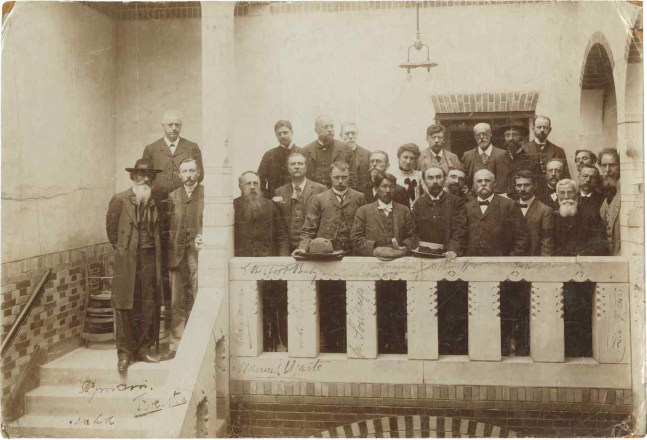
Picture: Karl Kautsky (third from right, back row) with other Second International leaders in 1904
Parliament can yield political results, but only if a principled and coherent workers’ party is strong. The democratic opportunities offered by an elected assembly are determined not only by its formal procedures but also by whether the working-class has its own political organisation. So Karl Kautsky argued in this text of 1892, translated into Russian by Vladimir Ulyanov (Lenin) in 1894. In other words, defending electoral democracy is important in Britain, the USA, Turkey, and elsewhere, but will be effective only it goes together with workers’ political organisation. For Kautsky at that time, these arguments went together with advocacy of breaking up the bourgeois standing army and top civil-service hierarchy, and replacing them with a militia and officials on workers’ wages, in line with the Paris Commune of 1871. At that time Kautsky did not think attention to parliament meant socialism through bit-by-bit reform, or lack of interest in strikes and demonstrations. Lenin later saw great gaps in Kautsky’s theorising, but never disdained party-election democracy.
Great capitalists can influence rulers and legislators directly, but the workers can do so only through parliamentary activity... The struggle of all the classes which depend upon legislative action for political influence is directed, in the modern state, on the one hand toward an increase in the power of the parliament (or congress) [i.e. over the unelected state machine], and on the other toward an increase in their own influence within the parliament. The power of parliament depends on the energy and courage of the classes behind it and on the energy and courage of the classes on which its will is to be imposed. The influence of a class within a parliament depends, in the first place, on the nature of the electoral law in force. It is dependent, further, upon the influence of the class in question among the voters, and, lastly, upon its aptitude for parliamentary work.
A word must be added on this last point. The bourgeoisie, with all sorts of talent at its command, has hitherto been able to manipulate parliaments to its own purpose. Therefore, small capitalists and farmers have in large numbers lost all faith in legislative action. Some of these have declared in favour of the substitution of direct legislation for legislation by representatives; others have denounced all forms of political activity. This may sound very revolutionary, but in reality it indicates nothing but the political bankruptcy of the classes involved.
Attitude
The proletariat is, however, more favourably situated in regard to parliamentary activity... So far as their attitude toward politics is concerned, they are raised far above the farmers and small capitalists. It is easier for them to grasp party principles and act on them uninfluenced by personal and local motives. Their conditions of life, moreover, make it possible for them to act together in great numbers for a common end. Their regular forms of activity accustom them to rigid discipline. Their unions are to them an excellent parliamentary school; they afford opportunities for training in parliamentary law and public speaking.
The proletariat is, therefore, in a position to form an independent party. It knows how to control its representatives. Moreover, it finds in its own ranks an increasing number of persons well fitted to represent it in legislative halls.
Whenever the proletariat engages in parliamentary activity as a self-conscious class, parliamentarism begins to change its character. It ceases to be a mere tool in the hands of the bourgeoisie. This very participation of the proletariat proves to be the most effective means of shaking up the hitherto indifferent divisions of the proletariat and giving them hope and confidence. It is the most powerful lever that can be utilised to raise the proletariat out of its economic, social and moral degradation.
The proletariat has, therefore, no reason to distrust parliamentary action; on the other hand, it has every reason to exert all its energy to increase the power of parliaments in their relation to other departments of government and to swell to the utmost its own parliamentary representation. Besides freedom of the press and the right to organise, the universal ballot is to be regarded as one of the conditions prerequisite to a sound development of the proletariat.
Comments?We welcome replies, corrections and debate pieces. Contact us