
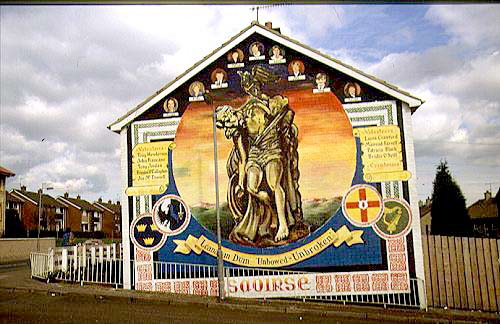
Wrapping up a series of articles on the great political upheaval in Northern Ireland in 1968-69. This instalment is about Britain putting troops onto the streets on 14 August 1969.
On 12 August 1969 serious fighting broke out in Derry at the Orange Apprentice Boys’ march around the well-preserved walls of the old city. It was the start of civil war, and it spread to Belfast after two days. The British army took over Derry, and then the Belfast areas where the Catholic minority was being attacked by Orangeists.
The People’s Democracy (PD) leaders in Derry, Eamonn McCann and Bernadette Devlin, called for British soldiers (Irish Press, 13.8.69: see Solidarity 734).
McCann and Devlin had adopted the policy of the left of the Labour Party in Parliament. They criticised Labour prime minister Harold Wilson for not having taken control already.
PD leader Michael Farrell did the same in Belfast [*]. (14 August).
The British army would remain as the scaffolding of the artificial Six County state for 38 years. Britain could offer no solution.
But Farrell identified the “basic cause of the trouble” as the “undisciplined and biased RUC”. That was not the “basic cause” of anything. The unjust partition and the creation of an artificial Catholic minority in the Six Counties was.
And the description in Farrell’s statement of the Orange supremacists as a “fascist band” was a Farrellism, plausible nonsense. They were communalists, not fascists. Such throwing-around of falsely-attributed names would always characterise PD.
For Farrell, the Orangeists had no right to be in Ireland. He would later compare them to the French pieds noirs in Algeria and in effect advocate an Algerian “solution” — driving the Orangeists out of Ireland. Farrell was a Catholic communalist.
In Britain, IS (forerunner of today’s SWP, and then linked with PD) was seriously disoriented.
Initially the Northern Ireland Catholics were friendly to the soldiers. British troops could only help the RUC, had said IS when it demagogically blazoned “troops out” on the front page of Socialist Worker a short time before.
But now the British government, with the army as its agent, disarmed the RUC, and the B-Specials were stood down and soon abolished. IS was left politically naked.
The first response of Socialist Worker (14 August) was written by the Christleite Gery Lawless. On the troops, it said that: “British imperialism can no more aid the struggle of the Irish people than petrol can quench fire”. That was true, and it was fundamental.
But by the next issue of SW (21 August), the IS leaders had taken over, and they took the PD line.
The IS leaders were always demagogic on Ireland, always had no sayable or defensible analysis, though some of them them had a line shaped in the discussions in Socialist Review (foreunner of IS) in 1957-8, and that showed through. In 1969 they always followed PD. In August 1969, in the wake of PD, they came out for the use of British troops. Long term considerations? Basics? All that was for other, less sophisticated, people!
The IS leaders defended themselves from the Trotskyist Tendency at the September 1969 IS conference with tremendous and shameless demagogy. Why were we against British troops? Because we wanted a bloodbath, that was why.
Was the problem that they had switched their line on British soldiers in the Six Counties from headlining Troops Out to following PD is saying that the British soldiers were essential to the Catholics? No! The problem was that we, the Trotskyist Tendency, allegedly wanted to repartition Northern Ireland.
The problem, they said, was not that they supported the existing Partition, but that we supported (in a Manchester branch resolution) the idea that the two Catholic majority counties and Derry City should secede from the Six Counties to the 26.
That, we mistakenly believed, would make the Six Counties unable to continue, and would begin a process of creating a united Ireland.
The “nationalist” floor of Irish politics was left to the Catholic nationalists and the Paisleyites. We tried to remedy that.
But the level of demagogy was such that it was impossible to discuss and explore anything. Much later, Jim Higgins told me that they thought the Trotskyist Tendency would lead a walk-out from the conference. Maybe, but that it only another way to say that they were very badly rattled by the collapse of their previous line on Ireland. The bloodbath nonsense was a way of appealing to the members of IS against us and giving themselves an excuse for the change of line. They got a big majority. The line was changed back to “troops out” six or seven months later when I moved a resolution at the National Committee to that effect.
Cliff used demagogy in speech, but he put forward others to commit it to paper. Here, he left it to one of IS’s young English gentlemen, Stephen Marks, whom he would later expel.
Marks translated Cliff’s wisdom on British troops in Ireland into would-be Bolshevik precedent.
Propaganda and “demands in the present situation”, explained Marks, were quite separate things, and need not be in agreement with each other. The issues he raised with that argument were of great importance way beyond the immediate issue.
Plekhanov
On the relation between “agitation” and “propaganda”, the classic Marxist statement had been G V Plekhanov’s in The Tasks of the Russian Social-Democrats in the Famine (1891). “Agitation is also propaganda, but propaganda that takes place in particular circumstances, that is in circumstances in which even those who would not normally pay any attention are forced to listen to the propagandist’s words. Propaganda is agitation that is conducted in the normal everyday course of the life of a particular country.
“If I had to clarify further the relationship between agitation and propaganda I should add that the propagandist conveys many ideas to a single person or to a few people, whereas the agitator conveys only one or a few ideas, but he conveys them to a whole mass of people, sometimes to almost the entire population of a particular locality”.
Marks wrote: “Those who would raise the demand for withdrawal now must explain how they would implement that demand if they were behind the barricades in Derry or Belfast. Would they fire on the troops now, and encourage others to do the same? If so, they would merely add their bullets to those of the Paisleyites and provoke an immediate clash in a situation which would lead to a massacre. But if they would not take this responsibility on themselves they would presumably be reduced to getting the troops out by persuasion — a difficult task!”
It had been all right nevertheless for Bernadette Devlin to see Paisley as a representative of the Orange workers, and ask him for a united front against the liberal Unionists? Ian Paisley said publicly that Devlin had done that, and he was not contradicted.
“To combine a demand for withdrawal with a demand for the arming of Catholic workers is to solve the problem only at the level of the mounting of slogans. In real life, the two demands are in contradiction if both raised at the present time, for the arming of the Catholics is dependent on the precarious breathing space the presence of the troops provides. But if the demand for withdrawal in the present situation does not flow from a false evaluation of the relation of forces, it can only mean one of two things:
• either the conscious advocacy of a massacre now, presumably as a means of raising the level of struggle (a demand we would invite the supporters to raise behind the barricades);
• or else it could be justified with the excuse that raising the slogan will not lead to the departure of the troops and therefore we need not reckon with the consequences. On this we need only say those who do not take their own slogans seriously cannot expect others to do so”.
IS had thus worked out a formula, as we commented, “whereby in slogans and headlines the troops shouldn’t be mentioned, but in the text we should ‘warn’ about their future role. In subsequent arguments the headlines and slogans were labelled ‘agitation’, the small type was the ‘propaganda’. We were told that one must ‘understand the difference between propaganda and agitation’...
“Underlying these arguments... was an absolute lack of clarity on the basic question. Why do we make demands? What are they for? Who are they addressed to? Throughout the discussions on the troops, the political effects (as opposed to the alleged physical effects) on the people of Belfast and Derry of either having or not having the ‘Withdraw Troops’ demand was never considered. The role of demands, of agitation and propaganda, in raising and developing consciousness and self-confidence among the workers, never came into it. The only people we were talking to, according to the conceptions of Marks and the EC, were the British authorities.
“Unless we have a clear conception that the reason for putting demands, for making agitation and propaganda, is directly to try to raise the level of consciousness, to show the necessary direction of the struggle, to sharpen that struggle so that the masses, or at least those of the vanguard that we reach, learn the best political lessons from it, we are hamstrung from the start, we are tied down to a reformist conception — to a stance of petitioning the powers that be, looking to their actions and decisions for alleviation, rather than to the direct action of the working class. If that were the case, we would never make a demand that wasn’t likely to be realised immediately.
“Moreover, if we do not see the various forms of ‘communication’ (demands, slogans, agitation, propaganda, headlines and small print) as necessarily bound together by a single aim and programme, with the single purpose of raising consciousness (whether this be ‘purely’ literary or whether it be linked with immediate action) then what is there to link them, to prevent them flying apart into contradictions and inconsistencies?
“For [Marxist] revolutionaries, there can be no contradiction between the content of agitation, propaganda and theory. The difference is one of form, of style and technique, and of scale. The content and meaning does not differ according to whether action might or might not follow, or whether that action might be on mass scale or on a tiny scale. This is the essential meaning of the well known definition of Plekhanov: ‘A propagandist presents many ideas to one or a few persons; an agitator present only one or a few ideas, but he presents them to a mass of people’.
“Marks, having no conception of the purpose of demands, departed quite explicitly from this formula: ‘Of course, this very situation’ (of contradictions, with the troops’ presence being approved) ‘increases the need to expose on every occasion in propaganda and discussion [our emphasis] the role the British troops are playing; and the side on which they must ultimately come down. But those who conclude that raising the demand for withdrawal in the present situation [emphasis Marks] must therefore follow, do not understand the difference between propaganda and agitation.”
“We say one thing in ‘discussion and propaganda’ and another ‘in the present situation’.
“Marks might have been paraphrasing Martynov, in that passage which Lenin (in What is to be Done?) sarcastically described as rendering Plekhanov more profound. ‘By agitation, in the strict sense of the word, we would understand calling the masses to certain concrete actions...’ In reply, Lenin demonstrated that all types of political writing were more or less directly connected with ‘action’. One couldn’t make that a criterion for separating out one type of work.
“To single out a third sphere, or third function, of practical activity [as well as propaganda and agitation] and to include in this third function ‘calling the masses to certain concrete actions’ is sheer nonsense, because the ‘call’, as a single act, either naturally and inevitably supplements the theoretical tract, propagandist pamphlet, and agitational speech or represents a purely executive function”.
Lenin gave an example of a “concrete action”, the signing of petitions: “The call for this action comes directly from the theoreticians, the propagandists and the agitators, and, indirectly, from those workers who carry the petition lists to the factories and to private houses to get signatures”.
“The point about the Plekhanov formulation is, of course that the ‘single idea’ put over in agitation is not just any old idea but a correct idea; not in antagonism to the larger complex of ideas that is propaganda, but flowing out of it and, again, leading back to it. Taking this definition together with IS’s practice, the only thing it can mean is that you tell most of your audience that the troops are indispensable to the Catholic workers, that the troops ‘for the moment’ and ‘in the present situation’ are doing a good job; while you tell an initiated few, who probably don’t really need to be told anyway, that things aren’t so simple.
“The justification for having a different line for agitation and propaganda was that given by Marks and Martynov: that agitation must lead to action, but propaganda is about the general, overall picture, about the future. Only propaganda is seen as educational. Martynov, the Russian ‘Economist’, counterposed agitation leading to action to Plekhanov’s propaganda and agitation, because he wanted to fight for reformism and to ‘free’ his reformist tactics from a too rigorous connection with revolutionary Marxist propaganda and the agitation spun from it. Marks and IS use the very same distinction, for the reason that they want to free themselves to react impressionistically with regard to the long-term interests of the class. They want to free themselves from theory, programme and basic principles”.
People’s Democracy
There were still two revelations about 1969 to come. When the Cameron Commission reported on 12 September 1969 on the fighting that broke out in Derry in January 1969, it revealed in passing that PD had no members, only a general assembly of students who could make and change policy at will, including more than once in the same meeting, so those with the political commitment to stay late decided what the seeming mass meeting did. Michael Farrell was not a student, but an ex-student college teacher.
Initially, PD had had large meetings, but they had become much smaller. Big meetings had initially rejected both PD candidacies in the Northern Ireland elections in March and the “Long March” from Belfast to Derry. (The “Long March” was an event in Maoist history). The vote was taken again when most people had left. The leaders “led” by such manipulation. PD was not much more than a make-believe organisation.
As has been said, essentially, PD was only a few leaders, ex-students like Farrell and Toman and, I think, the anarchist McGuffin, and the student Bernadette Devlin, and their relationship with the media and identification with the students at Queen’s University. McCann, though critical of Farrell, was in the media referred to as “PD”.
The PD leaders, Devlin, Farrell, McCann and others, called a press conference after Cameron reported at which they said they would shortly publish a rebuttal of Cameron. As far as I know, they never did. They couldn’t, because it was all true. A reply of sorts was given soon when PD became a (very small) membership organisation.
“Struggle in the North” and Irish autarky
Another political mystery was cleared up in December 1969, when the then IS publisher Pluto Press put out as its first publication Michael Farrell’s The Struggle in the North. (PD later reprinted it). It was revealed that Farrell advocated for Ireland a left variant of De Valera’s 1932-58 attempt at economic autarky. John Palmer had half-flirted with the idea in an article by Chris Gray and himself in International Socialism journal 36 (originally written to be a pamphlet), and it was impossible for the Trotskyist Tendency to see where that was coming from. It came from Farrell, who was very eclectic and incoherent and here, I think, taking Stalinist Cuba as his model.
Inside IS, “PD” was Cliff’s and Palmer’s relationship with Farrell. Farrell’s pamphlet functioned, and was used by the IS leaders responsible for the IS Irish debacle, as a reply to a pamphlet which Rachel Lever and I had written for the Trotskyist Tendency, IS and Ireland. Eventually, IS broke with Farrell and PD in 1972 or 73. PD had become a political satellite of the Provisional IRA. Then, at some point, as Socialist Democracy, it joined the Mandel Fourth International, which believed in “permanent revolution” for Ireland, i.e. that the Provo war could be the start of the socialist revolution in Ireland; and Farrell retired from politics.
The difference of the Trotskyist Tendency (Workers’ Fight) with the Cliffites was not that we knew it all (we didn’t: we were groping), but that we thought that Marxists should work at getting or seeking the truth, and then state it as bluntly as necessary. The Cliffites, including the critical Cliffites, did not understand Marxism like that. The important “Marxism”, for them, was something you added or invoked afterwards to back up what you had decided empirically.
For instance, on Ireland, I believed in 1969, and had already written, that talk of “British-occupied Ireland” implied conquering the Protestant workers, and naturally I was against that. I took a federal united Ireland as the only possible united Ireland as a result of the discussion in IS. I took things like that seriously. I tried to learn, with good or bad results.
Cliff was guided by the idea (and apparently said to the IS Executive Committee frequently) that “tactics contradict principles”. I would later hear him tell the NC that when in 1971 he was successfully advocating that IS should reverse its line on Europe and the European Union (then European Economic Community).
I don’t think that I properly understood in January 1969 that Cliff and Palmer stood for two Irish socialist revolutions, one in the Six and another in the 26 counties. That was not because I couldn’t see the meaning and implications of what they said, but because what they said was just too stupid (and they were not ordinarily stupid people).
An independent Six Counties was then and is now impossible: it would lead to civil war and the break-up of the sub-state. The idea of a stable independent Six County state that would in the fullness of time join in an independent Ireland was simply ludicrous, politically ridiculous.
The revolt in 1969 was not a revolt of “the people” (in general) of Northern Ireland. It was a Catholic revolt against being second-class citizens and an artificial minority in the Six Counties. Protestant involvement was an individual here and there.
In the early period in 1969, the Trotskyist Tendency called the IS leaders “Catholic economists”, people who related to the Northern Ireland revolt as if it would lead to socialism just by becoming more militant. Any such hope was nonsense, but it was what they seemed to believe.
[*] In his book The Orange State, Michael Farrell seriously misrepresents what happened in Belfast. PD and NICRA issued no joint call to the Catholics. PD could deploy at most ten people in Belfast.
Appendix 1
Tony Cliff had not taken part in the 1957-8 discussion in Socialist Review, and he did not take part in the 1969-70 written discussion. For preference he wrote background articles and filled in conclusions separately. I think Cliff did supply the two articles by Owen Sheehy Skeffington in Socialist Review of September and October 1957. Sheehy Skeffington was not a Marxist, didn’t claim to be, but a decent utopian socialist, an Irish Senator, and a friend of Cliff’s (by Cliff’s own account). He was the only member of the Dail to take up the question of violence in Irish schools when some Dublin citizens did. See Why did they stand for it?, online.
Appendix 2: IS and Marxist theory
Excerpt from a document given limited internal circulation in 1971 in Workers’ Fight (forerunner of Workers’ Liberty)
I agree that IS has contempt for theory. Why? Because the IS theory is the possession of a handful of mandarins, who function as both a group mandarinate and as a segment of normal academic Britain. What theory there is, is their theory: they are quite snobbish about it.
This is inseparable from a manipulationist conception of the organisation. The members don’t need to know the theories — the leaders can be relied upon — and demagogy and word-spinning phrase-mongers like Cliff and Palmer can bridge the gap. It is in this sense that IS has contempt for theory — contempt for the Marxist conception of theory and its necessary relationship to the organisation as a leaven and tool of the whole group. “Contempt” is not the best expression for it, though, is it? The priestly caste most certainly have contempt — for the uninitiated — but their theory is their special treasure, their badge of rank, their test for membership of the inner elite. There actually is such open caste snobbery in IS.
The real sense of IS’s “contempt for theory” is in their use of theory, the function of theory, the relationship of theory to practice: there is no connection between the two for IS. Do you know that in last week’s debate at the National Committee Cliff said and repeated that principles and tactics contradict each other in real life!
This is organically connected with their mandarinism. It is an esoteric knowledge — for if principles contradict tactics and practice, if theory is not a practical and necessary tool, if theory is not the source of precepts to guide practice, to aid in the practical exploration of reality — why then, where is the incentive to spread theoretical knowledge? What is to prevent the polarisation of the organisation into the mandarins and the subjects of the demagogic manipulation of the mandarins and their lieutenants? What is to prevent the esoteric knowledge of the mandarins from being just one intellectual “in-group”’s defining characteristic, to be played with and juggled with: after all it is very rarely tested, since it doesn’t relate to reality?
The central IS leadership are subjectively revolutionaries — but entirely bourgeois in their method of thinking and conception of politics. These people are very like the Lovestoneites (the Right Opposition group in the USA) referred to by Cannon and Trotsky. I’ve recently come across some of their material — and [Duncan] Hallas [of IS] could have written the anti-Trotskyist sections!
Do you know what I think our real problem is regarding this — say on the Common Market? [as the EU was called at the time: in 1971 IS switched from “in or out, the fight goes on”, to campaigning against British entry] It will help them grow, to gain strength, to avoid losses, and therefore to be imposing enough to continue to be the “natural” choice for raw leftists just coming on the scene — or at least a sizeable section of them. Opportunists who are capable and have resources and who are fortunate enough not to have to face principled opponents with a sizeable base and sizeable resources can always do that — in times of normalcy. The tragedy is that what is being built is not a revolutionary organisation that can stand up under pressure when needed. That’s why the sort of moral panic and collapse on Ireland in 1969 is so revealing and so significant for the understanding of IS.
Comments?We welcome replies, corrections and debate pieces. Contact us