
Part of a series of articles exploring the role of the left in the great political upheaval in Northern Ireland in 1968-69, written in response to John McAnulty’s polemic ( Solidarity 717)
In January 1969, as the old order in Northern Ireland was dramatically breaking down, IS (today SWP) was closely linked with People’s Democracy, and PD appeared as the big left-wing force in Northern Ireland. IS discussed Ireland as if anew.
But in fact some in IS did have a worked-out attitude. It underlay the policy adopted in January 1969 policy, though most of us at that IS National Committee (NC) meeting did not know that.
A stance on Ireland had been decided in the late mid 1950s, and it was very strange indeed.
Socialist Review had been the journal of the Socialist Review group, the 1950s forerunner of the International Socialists (IS) in the 1960s and 70s. A revived Socialist Review has been the magazine of the SWP since 1977.
In the first six years of its existence, from late 1950, Socialist Review had never said a word about Ireland. This is curious, and doubly curious because Tony Cliff, leader of the Socialist Review group, had been registered in Dublin as a student from 1947 to 1952, and had lived in Dublin for at least some of those years. He researched and wrote the book Stalin’s Satellites in Europe there.
For anyone needing to learn the nature of Irish politics, the politics of Partition, and of the 26 county Catholic-sectarian state, it would be difficult to find a period in Irish history offering such an intense and concentrated series of educational events as those afforded to the student Ygael Gluckstein [Cliff] in those years. For someone coming from Palestine, where Jews and Arabs interacted, it would have been riveting. In 1948, after 16 years of unbroken Fianna Fail rule under Eamon de Valera, a coalition government was formed around Fine Gael (the more conservative of the two leading parties: it had been Blueshirt for a while in the 1930s). It involved the then two Labour Parties, and would rule until June 1951. The mechanics and engines in Irish politics were revealed.
The Catholic bishops had brutally used their great power in the 26 Counties to veto an attempt by the Minister for Health, Dr. Noel Browne, to introduce free rudimentary health-care for mothers and children. It was a limited version of the British NHS, available too in the Six Counties, where the Catholic Church had not objected to it.
The 26 county Free State proclaimed itself a Republic in January 1949. Apart from leaving the Commonwealth and thus adding an additional obstacle to relations with northern Ireland, nothing changed. De Valera, who had built the republican elements in the Free State constitution and was now out of power, opposed the proclamation as a mere gesture that would harm relations with the Six Counties.
The Southern parties and the coalition government waged a big international propaganda campaign against Partition. That encouraged a revival of the physical force Republican movement, whose members believed that they could achieve with guns what the 26 Counties political Establishment had tried and failed to achieve with diplomacy and propaganda. Essentially their campaign (Dec 1956 to Feb 1962) consisted of raids into the Six Counties from the South.
In 1957, the Socialist Review (SR) group announced that it had fused with a few, Nottingham-based, recent Communist Party members. (Eventually they would be the original nucleus of the Mandel-Pablo Fourth International in Britain in the 1960s).
As a result of the fusion discussions, Socialist Review changed the statement of its principles that appeared in every issue. In the April 1957 issue, for the first time,Socialist Review took a stand on the “Irish question”. SR, it announced, was for “The reunification of an independent Ireland”.
This was an odd formulation. To Republicans and nationalists, a united Ireland fully separated from Britain was what they understood by independence. Certainly Socialist Review’s formulation begged a lot more questions than it answered. Strange, it surely was, but what did it mean?
That the Six Counties should become independent and then, at some point, unite with the 26 Counties? Meanwhile? For practical purposes socialists should recognise the existing partition? And what did it mean for the labour movement? For Irish socialists?
That the socialists and the workers’ movement should continue to be separate, North and South? In Northern Ireland militants would work, separately from their 26 Counties equivalents, for an independent Northern Ireland? In the North, they would explain that independence was necessary so that the two independent states could achieve the goal of all-Ireland unity? That they were against Irish unity, or calls for unity, until the Six Counties had won their independence from Britain? Meanwhile the revolutionary workers North and South should organise separately and conduct their struggles separately? For sure, when the IS majority at the January 1969 National Committee revived the 1957 stance, it posed very limited, though bizarre, goals.
On the face of it, Socialist Review’s new 1957 position was a pro-Partition variant of the call for a united Ireland. None of that was spelt out, and possibly it was not fully understood by some of the ultra-subtle people who had formulated the new position. There was no mention of the old 1957-8 discussions in the new discussion at the January 1969 NC.
It was typical of the group to first change the “line” in 1957 and then “discuss” it. They finally dropped the 1957 innovation. It would emerge in the discussion that followed, in Socialist Review in 1957 and again in 1958, that the new 1957 position was indeed that there should be two Irish socialist revolutions, and then maybe unity. The Stalinists were notorious among Trotskyists for advocating a two-stage Irish revolution — first “full” independence and reunification, then socialism. SR would stand this idea on its head, and create a variant even more senseless than the Stalinist one: first two separate socialist revolutions, then unification. The central stupidity of the position was that it assumed that the Six Counties was a stable entity. In fact, remove Britain from the equation, and there would be Catholic-Protestant civil war.
Discussion resumed in 1958, and ended with the SR group dropping its recently-adopted position for (a sort of) Irish unity on the stated grounds, ludicrous and preposterous, that they had unexpectedly discovered that there were differences amongst Irish socialists themselves on this question. “Unexpectedly discovered” might just have been true of the South African, Israeli, and then British Michael Kidron, but it could not have been true of the whole Socialist Review group — of Tony Cliff, for instance.
This was the start of the second period of IS work on Ireland. The first had been from 5 October 1968 to the January NC, and to my mind was summed up in Paul Foot’s celebration of a revolt of “the people” (in general), “do-it-yourself reformism”, and, above all, “direct action”. The second was IS’s Lawless period, with the interaction of Lawless’s old “physical force on principle” ideas and IS’s strange politics on Ireland.
At every meeting from January 1969 we would get from John Palmer an account of PD in Northern Ireland, what it was doing and trying to do. Michael Farrell was a sort of opposition, representing “militancy”, in the Northern Ireland Civil Rights Association (NICRA). Militancy was the thing: civil rights on the streets. But if all the Catholics were militant, they would do what exactly? And what about the majority in the Six Counties?
In practice, despite the NC vote for advocating Irish self-determination, IS ruled out referring to it. They backed the Catholic demands, and at the same time tried to ignore the fact that the basic civil right the Northern Ireland Catholics lacked, from which everything else flowed, was self-determination.
Self-determination was what all the demand for Catholic civil rights pointed to. It was raised implicitly whatever IS and PD said or thought.
People’s Democracy
The IS people in PD were IS of the time before Cliff had “centralised” IS, only more so. But PD itself did not exist as an organisation in Ireland. It existed as a name, a strange unnatural name and in the relationship of a few people — Michael Farrell, Eamonn McCann, Bernadette Devlin — with the British and Irish and international media. IS, even the IS National Committee, did not know that then, though I think Palmer knew. PD could do things, or appear to do things, because it had in the background the active support of the Republican movement, then Stalinist-led, before it split in December 1969. Its prominent people also included anarchists such as John McGovern. But what, politically, was Michael Farrell? That was never clear until his pamphlet Struggle in the North appeared in December 1969.
What were Michael Farrell and People’s Democracy doing in 1968-9? They were against “moderation”. Who was the main enemy in Northern Ireland? The Stone Age Orangeists who believed in keeping the Catholics in second-class citizenship? No! The main enemy was the reforming Unionist government under O’Neill and then his cousin Chichester-Clark as Northern Ireland prime ministers. And they were also against the official NICRA “moderates” who wanted reform too. Eamonn McCann coined what became one of their names for reformers — the “half a loaf Unionists”. But what was a full loaf? A united Ireland? Socialism? Another phrase coined by McCann, and used widely, talked of Unionists with hobnail boosts, and Unionists in carpet slippers. But hobnail boots could kick you to death.
All the militancy, for PD and IS, was advocated within the frame of Northern Ireland, where the Catholics then were a minority of roughly one-third. PD deliberately stoked up a Unionist backlash, with such things as “militant” street politics. They wanted both to keep the Six Counties entity and to stoke up the most backward, most right-wing, and most anti-Catholic of the Protestants, those most fearful of the big Catholic and nationalist minority and of the ostentatiously Catholic 26 Counties over the Border. They wanted the Orange backwoodsmen to win against the reforming Unionists? God knows. But what they said meant: yes.
They deliberately followed the US civil rights pattern. But in the US, the civil rights people could appeal to the US federal government against the bigots who were normally in the local majority. Who would PD appeal to? Logically, to the British or Irish governments. But the 26 Counties, with a population of barely three million, was far too weak. Britain held Northern Ireland. British direct rule was already the policy of the Labour left and their weekly paper Tribune.
Everything militant that PD did pointed either to Catholics being slaughtered by roused and fearful Protestant Unionists, or to British intervention. Maybe they understood that, but I don’t think they did yet. Nor did IS. IS just wanted to recruit a few members, preferably Irish workers in Britain. Nothing else mattered.
Did Michael Farrell know this? He must have understood it. IS, after PD, was the proverbial little boy who played with matches in the gunpowder room. The explosion was not long in coming.
After Devlin’s election
The IS campaign on Ireland in Britain decided in December 1968 led nowhere, and so Cliff wanted to abandon it. A pamphlet written for it by Chris Gray and John Palmer was downgraded to an article in the IS magazine. The article referred favourably and mysteriously to Fianna Fail’s and de Valera’s attempt at 26 counties autarky between 1932 and 1958. Just that, no explanation. (The explanation was PD).
Then the third and unexpected IS phase opened, with the election of Bernadette Devlin as “Unity” MP for mid-Ulster in April 1969.
She was 22. She was “idealistic” in the sense of wanting things she had no idea how to achieve — Catholic-Protestant working-class unity, for example. She worked in London at first as an IS MP (she later took up with the SLL-WRP), speaking at building sites and factories wherever there were Irish workers or sympathisers or political co-thinkers. She was a favourite of the mass media.
Neither Devlin nor her IS “handlers” were above letting it be understood that “Unity” MP meant Catholic-Protestant unity. She did campaign for unity in that sense, but in fact “Unity” in “Unity MP” meant Catholic-nationalist unity in the Mid-Ulster constituency. Catholics had a majority there, but if there were two credible Catholic candidates splitting the vote, the Unionists would win. Unity meant not Protestant-Catholic unity in the Six Counties, but Catholic unity in the mid-Ulster Westminster constituency.
But now, with Devlin as an MP, IS’s prospects were changed. Devlin got applause when, speaking to Irish workers in Britain and others, she called for “Connolly’s workers’ republic”. But the IS NC had voted against that? IS forgot its vote at the January NC against the workers’ republic being raised as a slogan. The IS leaders “forgot” that they had fought against it. There was no explanation. There rarely was.
A new IS-sponsored campaign was mooted and eventually declared, the Irish Civil Rights Solidarity Campaign.
IS’s relationship to PD was close and fraternal, The relationship was not that IS led PD, but that IS did its best to keep in line with PD.
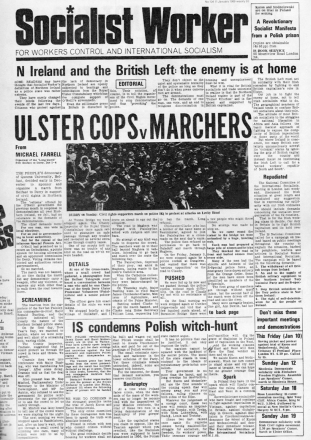
If all you read on Ireland was Socialist Worker, then, for all the time from 5 October 1968 to 13 August 1969, when British troops went on the streets, you would not know what was going on there or what would most likely happen there. Michael Farrell and PD were only valiant advocates and practitioners of street politics. When a power station was blown up and British troops were sent to guard power stations, Socialist Worker had a front page (26 April 1969) against the troops. Why? Well, you see, British troops could only be used to help the RUC, to free them to deal with the Catholics. To me, it seemed hollowed-out pseudo-nationalism. Typical IS demagogy.
IS tried most of the time to forget that there was an Orange majority in Northern Ireland and a Labour government in Westminster, and that a vocal wing of the Parliamentary Labour Party wanted direct rule of Northern Ireland from Westminster.
Comments?We welcome replies, corrections and debate pieces. Contact us