
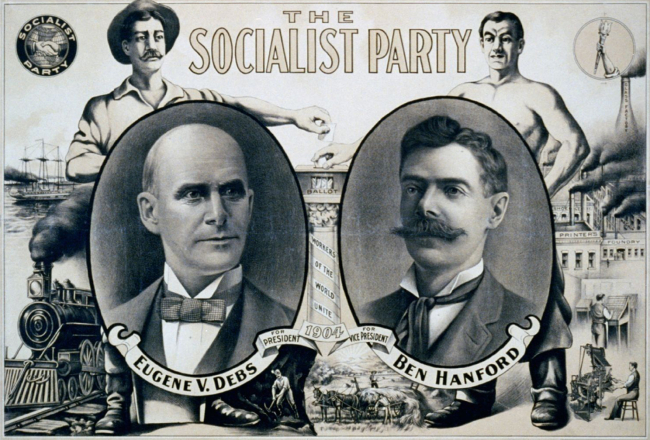
Our primary intervention into the political situation around the American election should be to point to the need for independent working-class political organisation, a social programme based on class interest. The American left and labour movement must fight Trumpism on a basis of working-class unity, including abortion rights, anti-racism, trans rights, and demands for radical social transformation on issues such as wages, housing, and healthcare.
Were we based in the US, that would include raising the call for an American workers’ party. No matter how you characterise the Trump movement, all comrades should agree on the necessity to organise independently against the far right as a political force. This position is undermined by calling for a vote for a capitalist party. By calling, in the first instance, for a vote for the Democratic Party, comrades in the majority have initiated a substantial change in line without properly accounting for it.
The majority is not a homogeneous bloc, so positions will have to be dealt with separately. We do not wish to tar some with the poor arguments of others. One section of the majority say that there has never been a rule against voting for bourgeois candidates; this is a misreading of the history of Marxism. Others argue that there was a general principle against supporting bourgeois candidates, which must be altered due to specifics of the current situation. A final group see attempts to rake over tradition as a quasi-religious practice, saying instead that the job of socialists is to assess the reality in front of us, and draw conclusions based on that assessment.
The tradition
Martin Thomas has presented his own former position on the Chirac/Le Pen election of 2002 as the primary example in our tradition of opposing a vote for bourgeois candidates. It is, of course, true that the majority of the history of independent working-class socialism cannot be neatly packaged under the label “don’t vote for capitalists”. Instead, at most points it has been expressed in positive terms: a duty to mobilise the working class as an independent force against the rule of the bosses, to convince workers to enact their own independent programme, organisation and mobilisation. If you wanted a pithy attempt to sum up the totality of our politics, that would be close.
Georgi Plekhanov puts it well, in his article The Tasks of the Social Democrats in the Famine, recently reprinted in Solidarity 706:
“A necessary condition for the victory of the proletariat is its recognition of its own position, its relations with its exploiters, its historic role and its socio-political tasks.
For this reason the new Socialists consider it their principal, perhaps even their only, duty to promote the growth of this consciousness among the proletariat, which for short they call its class consciousness.
The whole success of the socialist movement is measured for them in terms of the growth in the class consciousness of the proletariat. Everything that helps this growth they see as useful to their cause: everything that slows it down as harmful”.
In elections, this duty to working class independence is best expressed as standing independent candidates. As Karl Marx put it in 1850:
“Even where there is no prospect of achieving their election the workers must put up their own candidates to preserve their independence, to gauge their own strength and to bring their revolutionary position and party standpoint to public attention. They must not be led astray by the empty phrases of the democrats, who will maintain that the workers’ candidates will split the democratic party and offer the forces of reaction the chance of victory.”
Far before Martin Thomas, this has been expressed as a warning of the dangers of falling behind ruling class parties:
“A bloc of divergent political groups of the working class is sometimes completely indispensable for the solution of common practical problems... The joint force of such a bloc can prove far stronger than the sum of the forces of each of its component parts. On the contrary, the political alliance between the proletariat and the bourgeoisie, whose interests on basic questions in the present epoch diverge at an angle of 180 degrees, as a general rule is capable only of paralyzing the revolutionary force of the proletariat” - Leon Trotsky, Lessons of Spain, December 1937
Hal Draper put it most succinctly when discussing the “lesser evil” of voting for Lyndon B. Johnson to beat Barry Goldwater in the 1964 presidential election:
“So who was really the Lesser Evil in 1964? The point is that it is the question which is a disaster, not the answer. In set-ups where the choice is between one capitalist politician and another, the defeat comes in accepting the limitation to this choice.”
Nobody is saying that any socialist or socialist group is duty bound to agree with Marx, Plekhanov, Trotsky or Draper. Nor that a position in one concrete situation can necessarily be used as a blueprint for contemporary politics. Our tradition and theory aren’t a playbook with move for move plans for future struggle, but neither are they purely unique responses to unique events, with no relevance to the modern struggle. They are the distillation of debates and real-life experience of class struggle for over a century. Nobody should be dogmatically locked to tradition. But with no tradition, you lose your anchor. If comrades wish to make a turn, make an argument for it. Was Trotsky wrong in 1937 and Draper wrong in 1967? Or were they right at the time but the arguments are no longer relevant? If so, why?
On drinking poison
Some in the majority have use Trotsky’s metaphor, from an article on the United Front in Germany, that you would rather drink small daily doses of poison (the slow death of run-of-the-mill bourgeois politics) than be shot (the sudden, painful death of fascism). What they fail to explain is that Trotsky’s argument was both against Communists supporting the Hitler referendum, and the social democrats voting for liberals. He was not advocating that the German workers drank poison.
“The abstract question as to who is the lesser evil: Bruening or Hitler — is just as senseless. It is necessary to know which of these keys to strike. Is that clear? For the weak-minded let us cite another example. When one of my enemies sets before me small daily portions of poison and the second, on the other hand, is about to shoot straight at me, then I will first knock the revolver out of the hand of my second enemy, for this gives me an opportunity to get rid of my first enemy. But that does not at all mean that the poison is a ‘lesser evil’ in comparison to the revolver.
“The misfortune consists precisely of the fact that the leaders of the German Communist Party have placed themselves on the same ground as the social democracy only with inverted prefixes: the Social Democracy votes for Bruening, recognizing in him the lesser evil. The Communists on the other hand, who refuse to trust either Braun or Bruening in any way (and that is absolutely the correct way of acting), in the meantime go into the streets to support Hitler’s referendum, that is, the attempt of the Fascists to overthrow Bruening.”
Trotsky’s article does, indeed, call for blocs with the social democrats against the fascists (though we note that the Democrats are a long way from social democratic). But Trotsky makes very clear that such blocs are for mass street activity, not electoral agreements:
“Election agreements, parliamentary compromises concluded between the revolutionary party and the Social Democracy serve, as a rule, to the advantage of the Social Democracy. Practical agreements for mass action, for purposes of struggle, are always useful to the revolutionary party.”
The Bolsheviks in the Tsarist Duma
In the last several months’ debate, much hay has been made of the line, shorn from all political context, that ‘the Bolsheviks called for a Kadet vote against the Black Hundreds’. To respond fully to this claim would demand its own article, but comrades are encouraged to read the account of the Fourth Duma election campaigns by Badayev, as well as Lenin’s writings from the time.
The difference between the two elections, in our opinion, makes reading the Bolshevik position off as a justification of the majority position extremely questionable. In the Fourth Duma electoral system, workers were only allowed to vote in certain districts. The Bolsheviks stood a candidate in every such district. They also stood candidates in village districts and the “second city curiae”, where voters were mostly not workers. It is in this “second ballot for the election of electors in the city curiae” where, in order to give their own Duma representatives an easier time organising once the parliament had been elected, they called for a bloc with the Kadets against the Black Hundreds (or in some seats, a bloc with the Mensheviks and SRs against the Kadets).
In every seat where workers formed a majority of the electorate, the Bolsheviks stood their own candidate. The decision to form a bloc for some (not all) non-worker seats was based on improving the political situation for their own elected officials — the principle of independent workers’ politics was entirely upheld. This principle was even used as a stick to beat the Mensheviks, who entered into much more restrictive electoral blocs with the Kadets. Responding to a Menshevik article that said “one cannot expect the Cadets to become revolutionaries”, Lenin responded in no uncertain terms:
“Yes! But there is no reason why Social Democrats should declare themselves Cadets. […] By refusing to fight the Cadets you are leaving under the ideological influence of the Cadets masses of proletarians and semi proletarians who are capable of following the lead of the Social Democrats. Now or later, unless you cease to be socialists, you will have to fight independently, in spite of the Black Hundreds danger.”
This, in an election where the Mensheviks were already standing their own candidates, and producing their own election propaganda. The comparison to the majority position on the coming American election seems tenuous, to say the least.
The United Front and elections
Other comrades recognise a break, but say this is accounted for by the enormity of Trump’s threat. For this, we have to look at the origins of debates on lesser evilism and working-class anti-fascism in the movement.
The difference between Trump and Harris is undeniably more significant than Republican and Democrat candidates in the 1940s. But Draper and Trotsky’s main object for discussion is the rise of Hitler. The minority have been accused on multiple occasions of underplaying the seriousness of a Trump victory. So let’s be clear: a Trump presidency would be a threat to the tenets of democracy, to minorities of all stripes, and to class organisation. It is not, however, a greater threat to democracy, minorities and the class than Hitler was.
The notion of a “lesser evil vote” has arisen several times in our movement’s history. Each time, the severity and potential threat of the “greater evil” has been discarded as a reason to justify the lesser evil. Once more: this does not mean that it is inherently wrong to say so now. But comrades in the majority who take this view must justify the reason for a change in line.
One potential justification is that the writings of the 1930s don’t hold, because there is no organised working-class force on the scale of, for example, 1930s Germany. “We are third campists”, they say, “but in the absence of a third camp of any strength, pick one of the other sides”. This is the most credible form of the majority position.
We certainly have to recognise that the labour movement is weak, cowed, and disorganised; we must also offer solutions to the class from where they are. But if entryism was once justified as the united-front tactic adapted to conditions of the terrible weakness of the revolutionaries, then emblazoning our press with “Vote Biden/ Vote Macron” is the popular front tactic adapted to those same conditions.
Even where the labour movement appears weak, our primary job is to point to the need for independent working-class political organisation. This is not our election, these are not our candidates. Workers are being forced to make this choice, and these do not have to be the only options.
If we were a group in the US that work would have to begin before the election period, before the candidates were selected, and before the choice effectively narrowed to Democrat/Republican. Very little of our betwixt election coverage has been on the struggle to get unions to break from the Democrats, or what possibility there is within the DSA to plant a flag for working class political representation. Instead, it has largely been fawning pieces about “pro-union” Biden, a “good President”.
Across the world, we are seeing a wave of clashes between reactionary, racist, nationalist populism, and globalising, broadly-metropolitan free-market capitalism. The latter provides a greater degree of social freedom and more space for workers’ rights to be exercised.
But we do not give political confidence to the liberals. We do not even trust them to consistently fight for those elements of their own programme. Faced with a rising tide of racism and nationalism, the instinct of the liberal bourgeoisie is to triangulate with that nationalism in office, rather than confront it head-on. As Draper says, we are more and more faced with “the Lesser Evils who, as executors of the system, find themselves acting at every important juncture exactly like the Greater Evils.” (Neither Draper nor the current writers think that this means there is no difference between the two). The Bidens and the Macrons have fuelled the growth of the far right, doing nothing to attack inequality or poverty, allowing Trumps and Le Pens to pose as fighters for the “ordinary man”, from “outside the system”. They have fuelled the far right by constantly accepting racist fringe politics into the mainstream.
The left must advocate workers’ unity against all forms of racism, and for jobs and decent housing for all workers; for free healthcare for all and the end of student debt, and for genuine democracy. We must clearly state we are for migrants, black people, LGBT+ people.
We need to convince those who rightly fear Trump that working class unity can defeat the right. We need to convince those who wrongly see in Trumpism a solution to their miserable lives that it is class, not race or nationality, that is the fundamental divide in society. The only lasting cure for Trumpism is a healthy and fighting workers’ party. Waiting until election time, then calling primarily for a Democrat vote clouds this perspective, rather than clarifying it.
Comments?We welcome replies, corrections and debate pieces. Contact us